In short
World Diabetes Day falls on Saturday, November 14, so most workplaces will mark it on Thursday, November 12, or across that week.
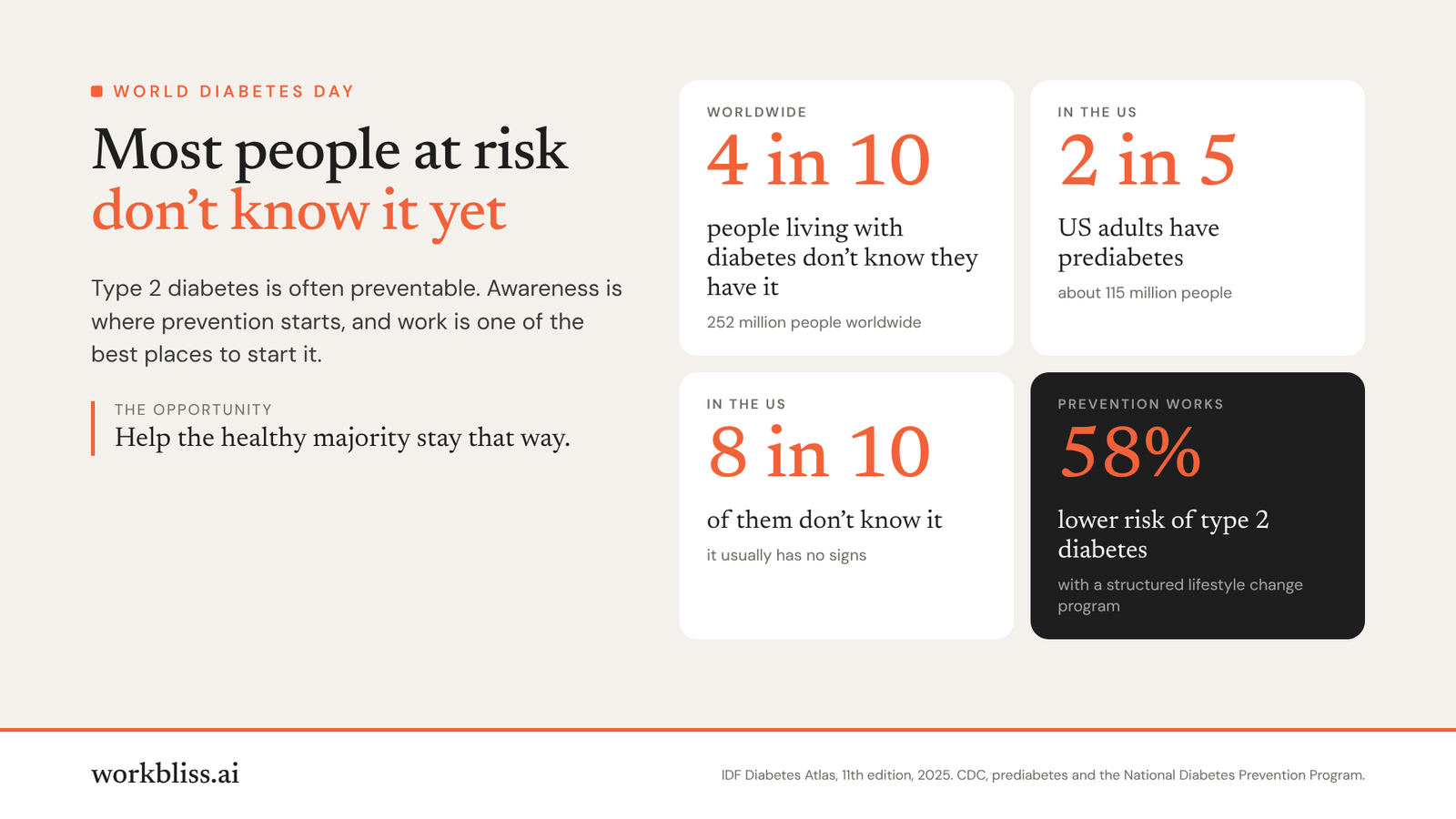
The biggest opportunity is prevention. Most people at risk of type 2 diabetes don't know it. More than 4 in 10 adults living with diabetes haven't been diagnosed, and in the United States, 8 in 10 people with prediabetes don't know they have it. Type 2 diabetes is often preventable, and the CDC reports that a structured lifestyle change program can cut the risk by 58% for people with prediabetes.
So the most useful World Diabetes Day at work is built for the healthy majority. It raises awareness, helps people know their numbers and builds the everyday habits that keep them healthy.
Why prevention is the opportunity
- 589 million adults aged 20 to 79 live with diabetes, about 1 in 9 adults worldwide, according to the IDF Diabetes Atlas (2025).
- 252 million of them, more than 4 in 10, don't know they have it.
- The number is projected to reach 853 million by 2050.
- In the United States, about 115 million adults have prediabetes, more than 2 in 5. Because it usually has no signs, 8 in 10 of them don't know they have it, according to the CDC.
Prediabetes is the stage where there's still time to change course. The CDC reports that people with prediabetes who join a structured lifestyle change program, built around healthier eating and more physical activity, can cut their risk of developing type 2 diabetes by 58%, and by 71% for people over 60.
Work is where most adults spend most of their waking hours. That makes it one of the best places to raise awareness and build habits that last.
How to bring World Diabetes Day to life at work
1. Pick your day
November 14 is a Saturday this year, so choose Thursday, November 12, or run something across the week of November 9. If your offices span time zones, run each session more than once, so nobody has to join at midnight.
2. Start with awareness
Most people have heard of diabetes, but few know what prediabetes is or what raises the risk. A short awareness session covers the basics in plain words. Share a one-minute risk test too, such as the CDC's prediabetes risk test or Diabetes UK's Know Your Risk tool, so people can check their own risk in private.
3. Help people know their numbers
A health check clinic lets people learn their numbers on the spot, and some will find out they're at risk while there's time to act. Use licensed providers, keep it voluntary and confidential, and make sure results go to the employee, not the employer. Check local rules on health data with your legal or data protection team first.
4. Teach the habits that lower risk
Short, practical sessions work better than a long lecture. Good topics include eating for steady energy through the workday, simple ways to move more at a desk or on a shift, and how blood sugar affects energy and mood. Give people one thing they can try the next day.
5. Make the healthy choice the easy one
If there's food at your event, make it the healthy option. A no-cook food demonstration, where people put together a snack or lunch they can make again at home, teaches more than a talk about nutrition. Add movement breaks to the day, and skip the cake.
6. Keep it going after the day
One day raises awareness. Habits take longer. Follow up with a four-week habit challenge, a short series of sessions, or a check-in session in the new year, when many people are already setting health goals.
7. Reach every office
Run sessions in the languages people speak, and make nutrition advice fit local food. Advice built around one country's diet won't work for a team in Mumbai, São Paulo or Manila. Give remote and frontline teams their own version, at a time they can actually join.
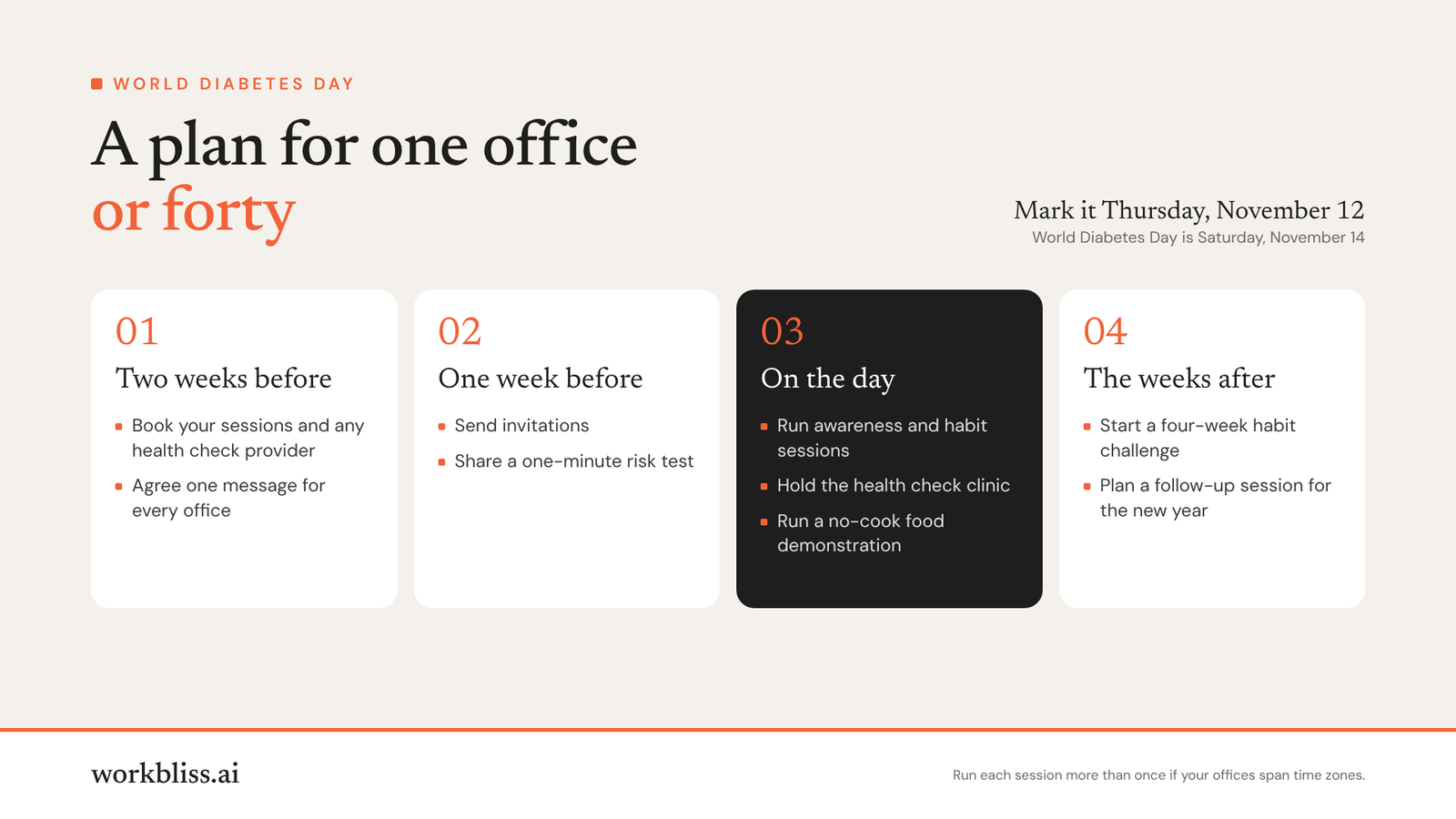
A simple plan for one office or forty
- Two weeks before: book your sessions and any health check provider, and agree the message for every office.
- One week before: send invitations, share a one-minute risk test, and give managers two or three lines to share with their teams.
- On the day: run the awareness and habit sessions, the health check clinic and the food demonstration.
- The weeks after: start a four-week habit challenge, and plan a follow-up session for the new year.
Where Workbliss fits
Workbliss runs prevention-focused workforce experience programs for global employers, with one plan and one point of contact for every office. Our World Diabetes Day bundle is four live sessions:
- Understanding Type 2 Diabetes and Prediabetes
- Diabetes Prevention and Everyday Blood-Sugar Health
- Nutrition for Stable Energy & Blood Sugar
- Blood Sugar and Your Heart
Prefer something hands-on? Take three of the sessions plus a no-cook food demonstration. You can also add a health check clinic, run by licensed providers. Every session runs online or in person, in your people's languages.
We need 14 days' notice, so book by Thursday, October 29, to mark the day on Thursday, November 12. If your date is closer than that, email hello@workbliss.ai and we'll see what we can do.
See the World Diabetes Day bundle
Frequently asked questions
When is World Diabetes Day 2026?
World Diabetes Day is on November 14 every year, the birthday of Sir Frederick Banting, who co-discovered insulin. In 2026 it falls on a Saturday, so many employers will mark it on Thursday, November 12.
Can type 2 diabetes be prevented?
Often, yes. Type 2 diabetes develops over time, and prediabetes is an early warning sign. The CDC reports that people with prediabetes who join a structured lifestyle change program can cut their risk by 58%. Type 1 diabetes is different: it isn't caused by lifestyle and can't currently be prevented.
What is prediabetes?
Prediabetes means blood sugar levels are higher than normal, but not high enough to be diagnosed as type 2 diabetes. It usually has no signs, which is why most people who have it don't know. A simple blood test can show it.
Can we run health checks at work?
Yes, if they're run by licensed providers, are voluntary and confidential, and send results to the employee rather than the employer. Rules on health data vary by country, so check with your legal or data protection team first.
How can employers support employees who already live with diabetes?
The International Diabetes Federation recommends that employers make health conversations feel safe, put a clear policy in place, raise awareness among all staff, and offer flexibility, such as flexible breaks and a private space for glucose checks or insulin.
What is the World Diabetes Day theme?
The International Diabetes Federation's theme for 2024 to 2026 is diabetes and well-being.
Sources
- International Diabetes Federation, "Over 250 million people worldwide unaware they have diabetes, according to new IDF research," April 7, 2025 (IDF Diabetes Atlas, 11th edition). https://idf.org/news-and-resources/news/idf-diabetes-atlas-11th-edition/
- Centers for Disease Control and Prevention, "Preventing Type 2 Diabetes." https://www.cdc.gov/diabetes/prevention-type-2/index.html
- Centers for Disease Control and Prevention, "About the National Diabetes Prevention Program." https://www.cdc.gov/diabetes-prevention/programs/index.html
- International Diabetes Federation, "Negative workplace treatment affects 40% of employees living with diabetes," November 12, 2025. https://idf.org/news-and-resources/news/negative-workplace-treatment/
- World Diabetes Day, "About World Diabetes Day," 2026. https://worlddiabetesday.org/