In short
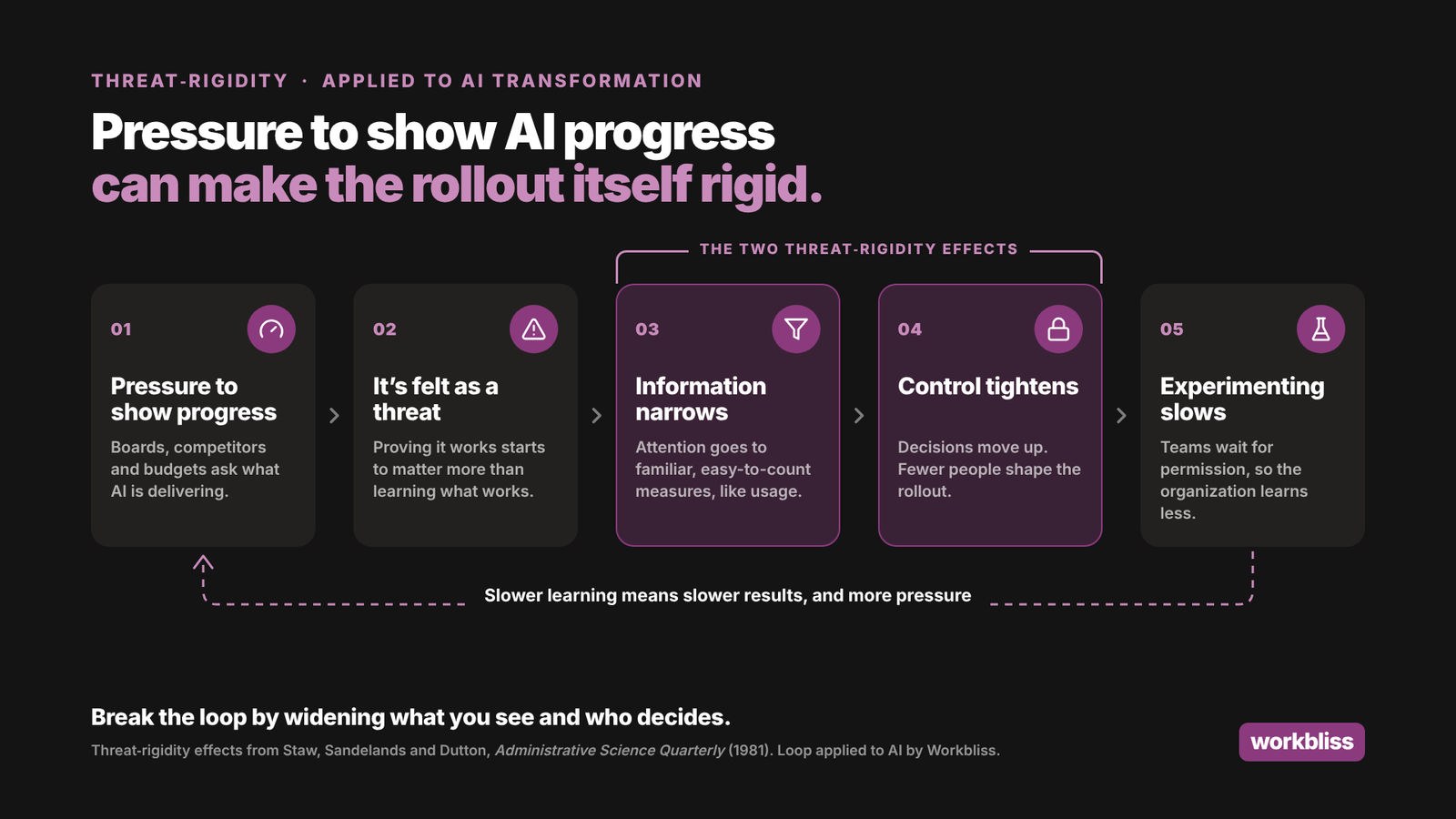
AI transformation in the workplace asks organizations to learn something genuinely new, and to learn it fast. Pressure to show progress can trigger a well-documented pattern called threat-rigidity. Under threat, organizations tend to take in less information and tighten control, which is the opposite of what AI adoption needs. HR can counter it by deliberately widening two things: what the organization pays attention to, and who gets a say in how AI is used.
What is AI transformation in the workplace?
AI transformation is more than rolling out AI tools. It's the change in how work actually gets done once AI is part of it: which tasks people keep, which they hand to AI, how decisions are made and what good work looks like.
A rollout can be finished in a quarter. A transformation takes as long as it takes people to find new ways of working that hold up. The gap between the two is where pressure builds, and pressure changes how organizations behave.
What is threat-rigidity?
In 1981, organizational researchers Barry Staw, Lloyd Sandelands and Jane Dutton reviewed evidence on how individuals, groups and organizations respond to threat. They described the same two effects at every level:
- Information narrows. People take in less, focus on what's most familiar and fall back on responses they already know.
- Control tightens. Decisions move toward the top, and fewer people are involved in making them.
Familiar responses aren't always a mistake. When a threat looks like something an organization has handled before, a well-practiced response may be exactly right. The difficulty comes when the situation is genuinely new and the familiar response no longer fits. For many organizations, AI is that kind of situation.
How AI pressure can make a rollout rigid
Threat-rigidity is often used to explain employees who resist change. It works just as well in the other direction. Under pressure to show progress on AI, whether from boards, competitors or budget reviews, an organization can respond in very understandable ways:
- Design the rollout centrally, with a small group making most of the decisions.
- Track progress mainly through usage dashboards, because usage is easy to count.
- Answer slow adoption with more training, because training is a familiar response.
- Pause experiments until every policy question is settled.
Each of these makes sense on its own. Together, they can narrow what the organization sees and who decides, at exactly the moment it most needs to learn from the people doing the work.
This is our reading of the research. The 1981 paper predates today's AI tools, but the pattern it describes is easy to recognize in an AI rollout.
What the research says helps
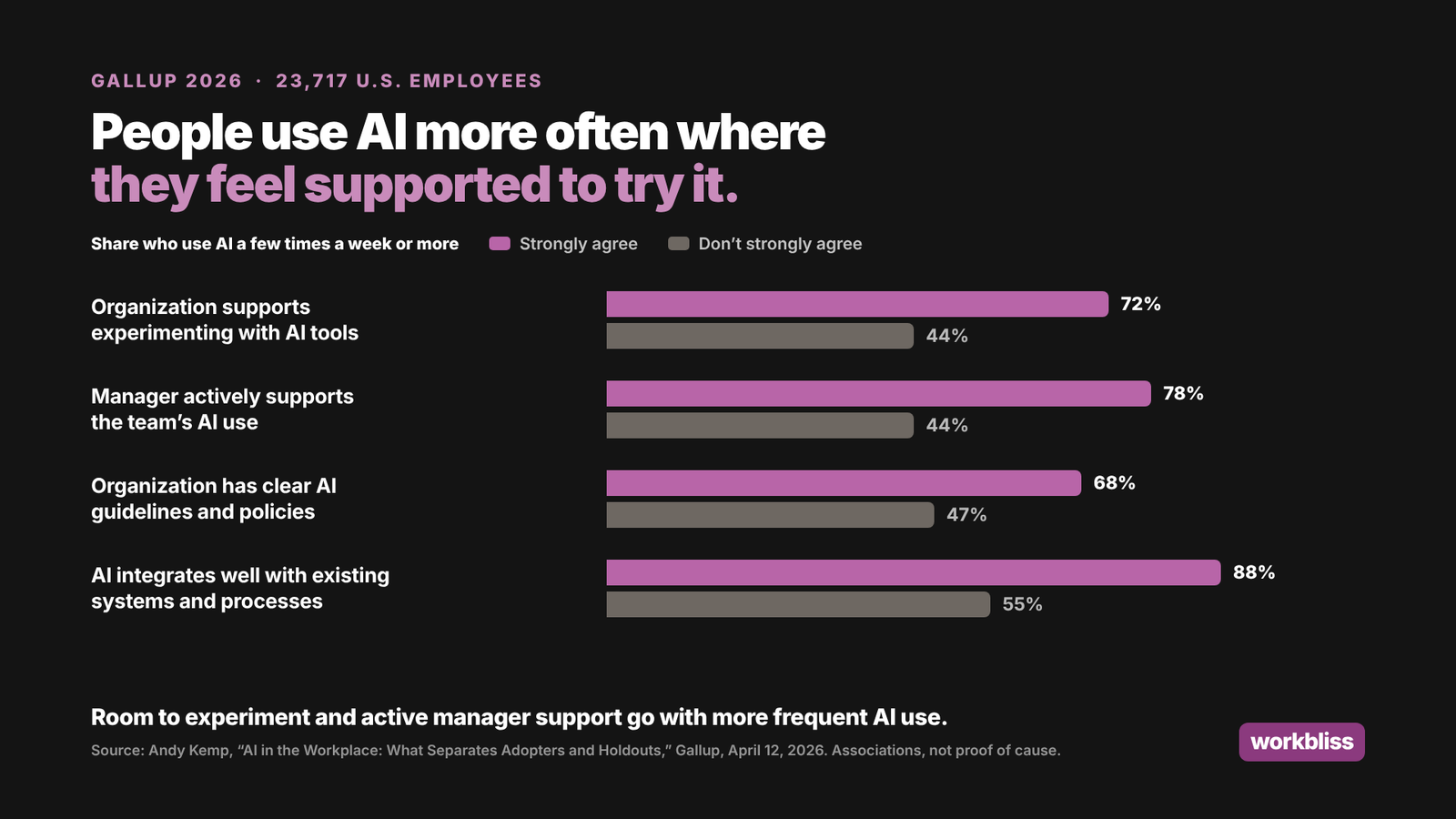
Recent data points away from rigidity. Gallup's February 2026 survey of 23,717 U.S. employees looked at how often people use AI depending on the support around them.
Among employees who strongly agreed that their organization supports experimenting with AI tools, 72% used AI frequently, meaning a few times a week or more. Among those who didn't strongly agree, it was 44%. Manager support showed the same pattern: 78% frequent use where employees strongly agreed that their manager actively supports the team's AI use, compared with 44% where they didn't.
The OECD's 2023 surveys of employers and workers in finance and manufacturing, across seven countries, found that training and worker consultation were both associated with better outcomes for workers. Consulting workers is the opposite of control tightening.
These are associations, not proof that one causes the other. But they point in the same direction: AI use grows where people have room to try things and a say in how it's done.
What HR can do: widen what you see and who decides
If threat narrows information and concentrates control, the practical response is to widen both on purpose.
Widen what you see
- Ask which concern applies before choosing a response. Gallup found that employees who don't use AI give very different reasons, from preferring their current methods to ethical objections, data concerns and doubts that AI can help with their work. Each needs a different answer, and only some of them are about skills.
- Look at the quality of work, not just how often people use AI. Usage numbers show activity. They don't show whether the work is getting better.
- Bring in signals from the people doing the work, such as short team retros and the questions managers hear every week.
Widen who decides
- Let teams help choose the tasks AI is piloted on. They know where the repetitive, low-value work is.
- Give every concern raised an owner and a response date, so people can see their input go somewhere.
- Set clear guardrails, then leave room to experiment within them. In Gallup's data, clear guidelines and support for experimenting both went with more frequent AI use.
A five-point rigidity check for your AI rollout
- Who made the main decisions about our AI rollout, and how many of them will use the tools every day?
- What are we measuring besides usage?
- Do we know which concerns are holding people back, team by team?
- When adoption is slow, is our first response always more training?
- Do people know what they're allowed to try with AI without asking permission?
These questions are Workbliss's way of putting the research to work. They aren't part of the original study.
Where Workbliss fits
Workbliss helps HR teams widen the AI conversation. Our programs include workshops that help teams surface what's really holding them back, manager programs that equip managers to actively support their teams' AI use, and learning programs built around each team's real work.
Because Workbliss runs programs in 48 countries and territories, global companies can take one consistent approach everywhere while each team shapes how AI fits its own work. The Workbliss platform, coming soon, will bring these programs together in one place.
Want more of your people shaping your AI rollout?
Tell us about your teams and your goals, and we'll suggest a program that fits.
Frequently asked questions
What is threat-rigidity?
Threat-rigidity is a pattern described by Barry Staw, Lloyd Sandelands and Jane Dutton in 1981. When individuals, groups or organizations feel threatened, they tend to take in less information, rely on familiar responses and centralize control. That can help when the threat is familiar, but it can backfire when the situation is new.
How does threat-rigidity apply to AI transformation?
Pressure to show AI progress can feel like a threat to leaders and organizations. Under that pressure, rollouts can become more centralized and more focused on easy-to-count measures, which can limit the experimenting and feedback that AI adoption depends on.
How can HR encourage AI experimentation safely?
Set clear guardrails on data, privacy and quality, then give teams room to try AI on real tasks within them. Involve employees in choosing pilot tasks, make sure managers actively support their teams' AI use, and give every concern a named owner and a response date.
What's the difference between AI adoption and AI transformation?
AI adoption is about whether people use AI tools. AI transformation is about whether work itself changes for the better as a result: how tasks are divided, how decisions are made and what good work looks like.
Sources
- Barry M. Staw, Lloyd E. Sandelands and Jane E. Dutton, "Threat-Rigidity Effects in Organizational Behavior: A Multilevel Analysis," Administrative Science Quarterly 26, no. 4 (1981): 501–524. https://www.jstor.org/stable/2392337
- Andy Kemp, "AI in the Workplace: What Separates Adopters and Holdouts," Gallup, April 12, 2026. Survey of 23,717 employed U.S. adults, February 4–19, 2026. https://www.gallup.com/workplace/704252/workplace-separates-adopters-holdouts.aspx
- Marguerita Lane, Morgan Williams and Stijn Broecke, "The Impact of AI on the Workplace: Main Findings from the OECD AI Surveys of Employers and Workers," OECD Social, Employment and Migration Working Papers, no. 288 (2023). https://doi.org/10.1787/ea0a0fe1-en