In short
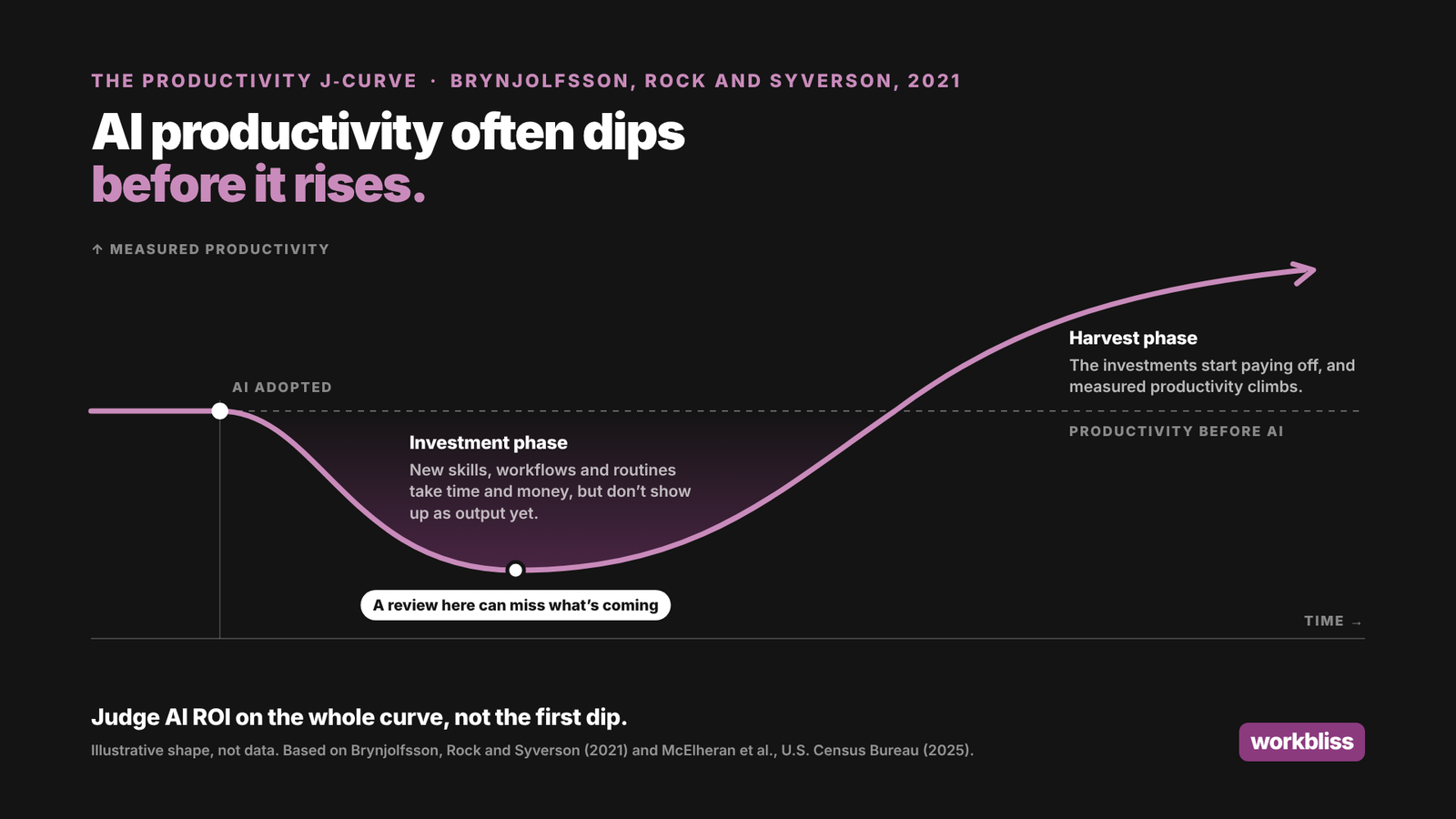
Many organizations are using AI but not yet seeing it in their productivity numbers. Economists Erik Brynjolfsson, Daniel Rock and Chad Syverson call this the productivity J-curve. A new general-purpose technology needs big investments in skills, processes and ways of working before it pays off, so measured productivity can dip before it rises. Much of that investment is people work, which puts HR at the center of AI ROI.
Why isn't AI showing up in productivity yet?
A February 2026 study of nearly 6,000 senior executives at firms in the U.S., the U.K., Germany and Australia found that 69% of firms actively use AI. Yet nine in ten executives reported no impact on employment or productivity at their own firm over the previous three years. They still expected AI to raise productivity at their firms by an average of 1.4% over the next three years.
It's easy to read that gap as a sign that AI isn't working. The J-curve offers another reading: the return arrives in stages, and the first stage looks like a cost.
What is the productivity J-curve?
In a 2021 paper, Brynjolfsson, Rock and Syverson wrote that "general purpose technologies (GPTs) like AI enable and require significant complementary investments." Those investments are mostly intangible: new skills, redesigned processes, new management practices and new ways of organizing work.
Intangibles take time and money to build, but they don't show up as output while they're being built. So in a new technology's early years, measured productivity growth is underestimated. Later, when the intangible investments start paying off, it's overestimated. Plotted over time, measured productivity traces a J: down first, then up.
What the dip looks like inside real organizations
The J-curve isn't only a theory about national statistics. A 2025 U.S. Census Bureau working paper by Kristina McElheran, Mu-Jeung Yang, Zachary Kroff and Erik Brynjolfsson studied AI adoption in U.S. manufacturing. The authors report "causal evidence of J-curve-shaped returns, where short-term performance losses precede longer-term gains."
Three details matter for HR:
- The losses were concentrated among older businesses.
- Firms that adopted AI earlier showed stronger growth over time, among those that survived.
- Roughly one-third of the losses were explained by firms abandoning structured production-management practices.
That last point is striking. A large part of the dip wasn't the technology itself. It was what happened to how work was managed while the technology arrived.
The same thing can happen at the level of everyday work. Time saved by AI in one place can be partly spent checking and fixing AI output in another, so the net gain is smaller than the headline time saved.
What goes into the dip, and who owns it
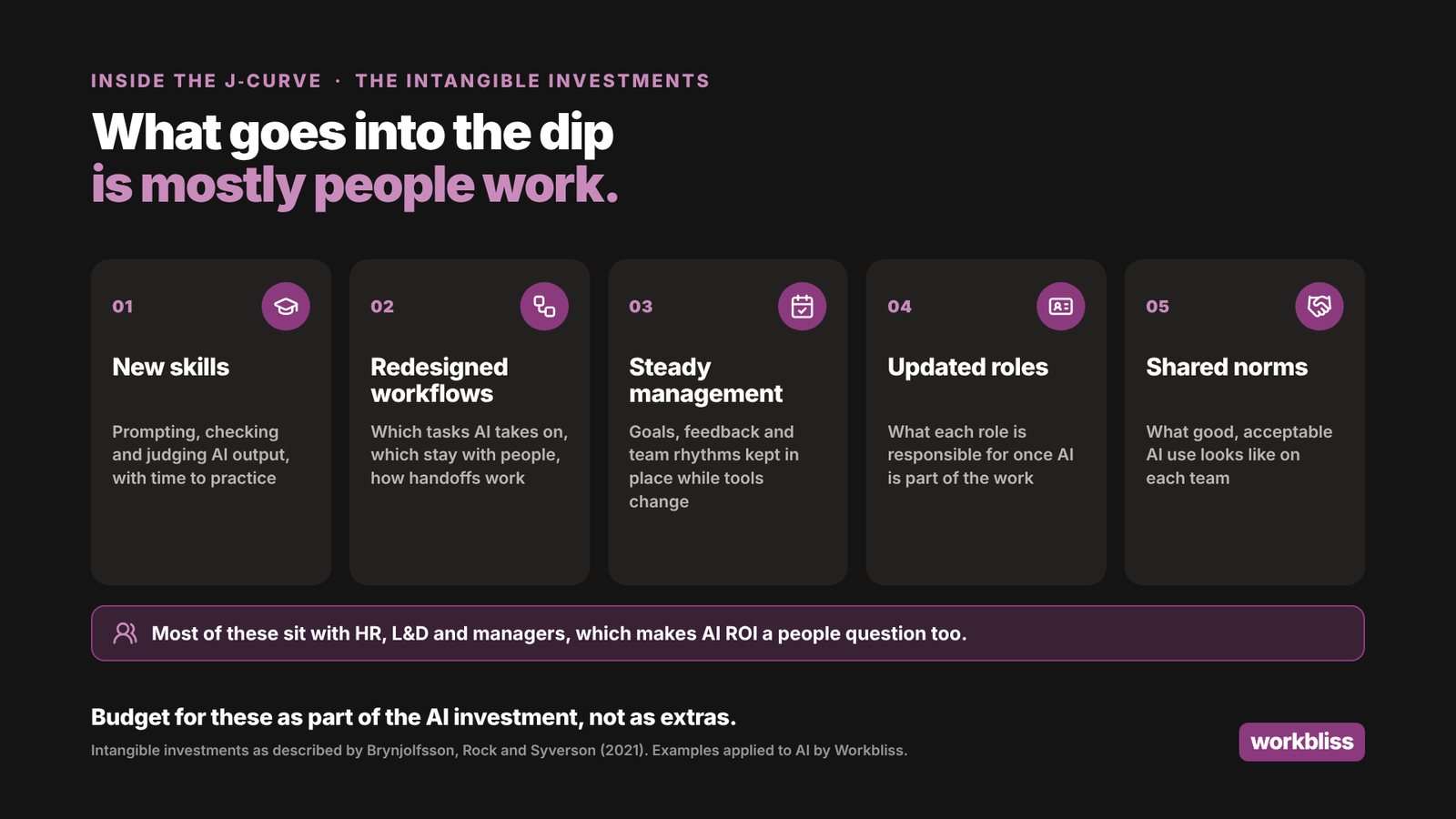
The intangible investments behind the J-curve aren't abstract. In an AI rollout, they look like this:
- New skills: learning to prompt, check and judge AI output, with time to practice.
- Redesigned workflows: deciding which tasks AI takes on, which stay with people and how handoffs work.
- Steady management: keeping goals, feedback and team rhythms in place while tools change.
- Updated roles: clarifying what each role is responsible for once AI is part of the work.
- Shared norms: agreeing what good, acceptable AI use looks like on each team.
Most of these sit with HR, L&D and managers. That makes AI ROI as much a people question as a technology one.
Who gains first?
The gains don't arrive evenly. In a study of 5,172 customer-support agents, published in 2025, Brynjolfsson, Danielle Li and Lindsey Raymond found that access to an AI assistant raised productivity, measured by issues resolved per hour, by 15% on average. Less experienced and lower-skilled workers improved both the speed and the quality of their work. The most experienced and highest-skilled workers saw small gains in speed and small declines in quality.
For HR, that means one average can hide very different experiences. Newer employees may need help building judgment as quickly as AI builds their speed. Experienced people may need room to apply their expertise where AI falls short, rather than being measured on speed alone.
What to measure while you're in the dip
| What to measure | Why it matters |
|---|---|
| Time saved, minus time spent on rework | Shows the net gain, not just the headline time saved |
| Quality of work | Speed gains can hide changes in quality, especially for experienced staff |
| Confidence and skills | Growing confidence is an early sign that the investment is building |
| Workflows redesigned | Shows whether teams are changing how work is done, not just adding a tool |
| Management routines kept | Steady goals, feedback and team rhythms help protect performance through the dip |
How HR can help shorten the dip
- Set expectations early. Tell leaders and teams that a dip is normal, and agree in advance what progress should look like at three, six and twelve months.
- Budget for the intangibles. Practice time, workflow redesign sessions and manager support are part of the AI investment, not extras.
- Protect management routines. Keep one-on-ones, goals and feedback steady while the tools change.
- Support different groups differently. Match support to experience levels rather than giving everyone the same training.
- Track rework, not just time saved.
These are Workbliss's recommendations based on the research, not findings of the studies themselves.
Where Workbliss fits
Workbliss helps HR teams make the people investments that the J-curve depends on. Our programs include learning programs that build AI skills around each team's real work, workshops that help teams redesign how work flows, and manager programs that keep teams steady through the change.
Because Workbliss runs programs in 48 countries and territories, global companies can invest consistently everywhere. The Workbliss platform, coming soon, will bring these programs together in one place.
Building the people side of your AI investment?
Tell us about your teams and your goals, and we'll suggest a program that fits.
Related reading: AI Change Management: Why Rollouts Plan the Change but Not the Transition
Frequently asked questions
What is the productivity J-curve?
The productivity J-curve is an idea from economists Erik Brynjolfsson, Daniel Rock and Chad Syverson (2021). New general-purpose technologies like AI require large investments in skills, processes and organization that don't show up as output at first. Measured productivity can dip before it rises, tracing a J shape over time.
Why is AI ROI so hard to measure?
Much of the early investment in AI is intangible, such as training, workflow redesign and new management practices. These costs are real but don't appear as output, and time saved can be offset by extra work such as checking AI output. Early measurements can make AI look less valuable than it may become.
How long does the AI productivity dip last?
There's no fixed length. It depends on how quickly organizations make the complementary investments. In McElheran and colleagues' study of U.S. manufacturing, firms that adopted AI earlier showed stronger growth over time, among those that survived.
Who benefits most from generative AI at work?
In Brynjolfsson, Li and Raymond's study of customer-support agents, less experienced and lower-skilled workers gained the most, improving both speed and quality. The most experienced workers saw small gains in speed and small declines in quality.
Sources
- Erik Brynjolfsson, Daniel Rock and Chad Syverson, "The Productivity J-Curve: How Intangibles Complement General Purpose Technologies," American Economic Journal: Macroeconomics 13, no. 1 (2021): 333–372. https://www.aeaweb.org/articles?id=10.1257/mac.20180386
- Kristina McElheran, Mu-Jeung Yang, Zachary Kroff and Erik Brynjolfsson, "The Rise of Industrial AI in America: Microfoundations of the Productivity J-curve(s)," U.S. Census Bureau, Center for Economic Studies Working Paper CES-WP-25-27, April 2025. https://www.census.gov/library/working-papers/2025/adrm/CES-WP-25-27.html
- Erik Brynjolfsson, Danielle Li and Lindsey Raymond, "Generative AI at Work," Quarterly Journal of Economics 140, no. 2 (2025): 889–942. https://academic.oup.com/qje/article/140/2/889/7990658
- Ivan Yotzov et al., "Firm Data on AI," NBER Working Paper 34836, February 2026. https://www.nber.org/papers/w34836