In short
AI change management usually focuses on the change itself: the tools, the training and the launch date. William Bridges, who spent decades advising organizations through change, argued that the change is rarely what holds people back. The transition is. That's the inner process of letting go of an old way of working, getting through an uncertain middle, and committing to a new one. An AI rollout that plans for all three phases gives people a far better chance of actually adopting the tools.
What is AI change management?
AI change management is the work of helping an organization and its people move from how they work today to working well with AI. It has a practical side: tool access, data rules, training and communications. It also has a human side: how people feel about the change, what they think they're losing, and what support they need to work differently.
AI rollout plans tend to be strong on the practical side, because it's concrete and easy to schedule. The human side is harder to see, and that's where Bridges' work is most useful.
What's the difference between change and transition?
Bridges drew a clear line between the two. Change is situational: a new system, a new process, a new tool. Transition is "the psychological process people go through to come to terms with the new situation."
His best-known line sums it up: "It isn't the changes that do you in, it's the transitions."
The two run on different clocks. A change can happen on a set date. You can switch on an AI assistant for 10,000 people on a Monday morning. A transition happens at each person's own pace, and it doesn't start with the new thing. It starts with an ending: letting go of the old way. As Bridges put it, "Unless transition occurs, change will not work."
That's why an AI tool can be live across a company while day-to-day work hasn't changed much at all.
The three phases of transition, applied to AI
Bridges described three phases. People don't move through them in a neat line, and different people are in different phases at the same time. Each phase asks something different of HR and leaders.
| Phase | What it feels like | What AI plans usually cover | What to add |
|---|---|---|---|
| Endings | Letting go of a familiar way of working, and the skills and status tied to it | Announcements, tool access, usage policy | Name what's ending and what isn't. Acknowledge what people are giving up. |
| Neutral zone | The old way has gone, but the new way doesn't feel natural yet. Work can feel slower and less certain. | Training sessions, help guides | Temporary support, permission to be slower for a while, and a place to take questions |
| New beginnings | The new way starts to feel normal, and people commit to it | Usage dashboards, success stories | The four Ps: a purpose, a picture, a plan and a part to play for each person |
Endings: what people are giving up
Every AI rollout ends something, even when it's an upgrade. It might be a way of drafting reports someone has refined for ten years. It might be the expertise that made a person the go-to on their team. It might simply be the satisfaction of doing a task well by hand.
Gallup's February 2026 survey of more than 23,000 U.S. employees hints at how this shows up. Among employees who don't use AI at all, in organizations where it's available, the most common reason wasn't a lack of skills. 46% said they prefer to keep doing their work the way they do now. Only 17% said they didn't feel prepared to use AI effectively.
Training answers the second problem. It doesn't answer the first. Some of that 46% may be about what people would be giving up.
Bridges' advice for endings translates well to AI:
- Ask who is losing what. Think about routines, expertise, status and control, not just tasks.
- Be clear about what's over and what isn't. "AI drafts the first version, and you still make the final call" is more reassuring than a general promise that nothing is changing.
- Mark the ending. A team session to agree what the old process got right, and what to keep, helps people let go.
- Treat the past with respect. The old way worked for its time, and saying so costs nothing.
The neutral zone: the uncomfortable middle
The neutral zone is the in-between. People have started using AI, but it doesn't feel natural yet. Work can take longer before it gets quicker, because people are checking AI output, building new habits and working out where the tool helps and where it doesn't.
This is the phase where people are most likely to drift quietly back to the old way. Bridges also saw it as the phase with the most potential for new ideas, because old routines have loosened and people are more open to experimenting.
What helps in the neutral zone:
- Temporary structures. Bridges recommended short-term arrangements to carry people through, such as interim processes and regular check-ins. For AI, that could be a weekly 20-minute "what worked, what didn't" huddle for the first two months.
- Permission to be slower for a while. If targets don't flex during the learning period, people will protect their numbers by sticking to what they know.
- A named person to ask. A go-to person on each team, a peer champion or a simple shared channel gives people somewhere to take the questions training didn't cover.
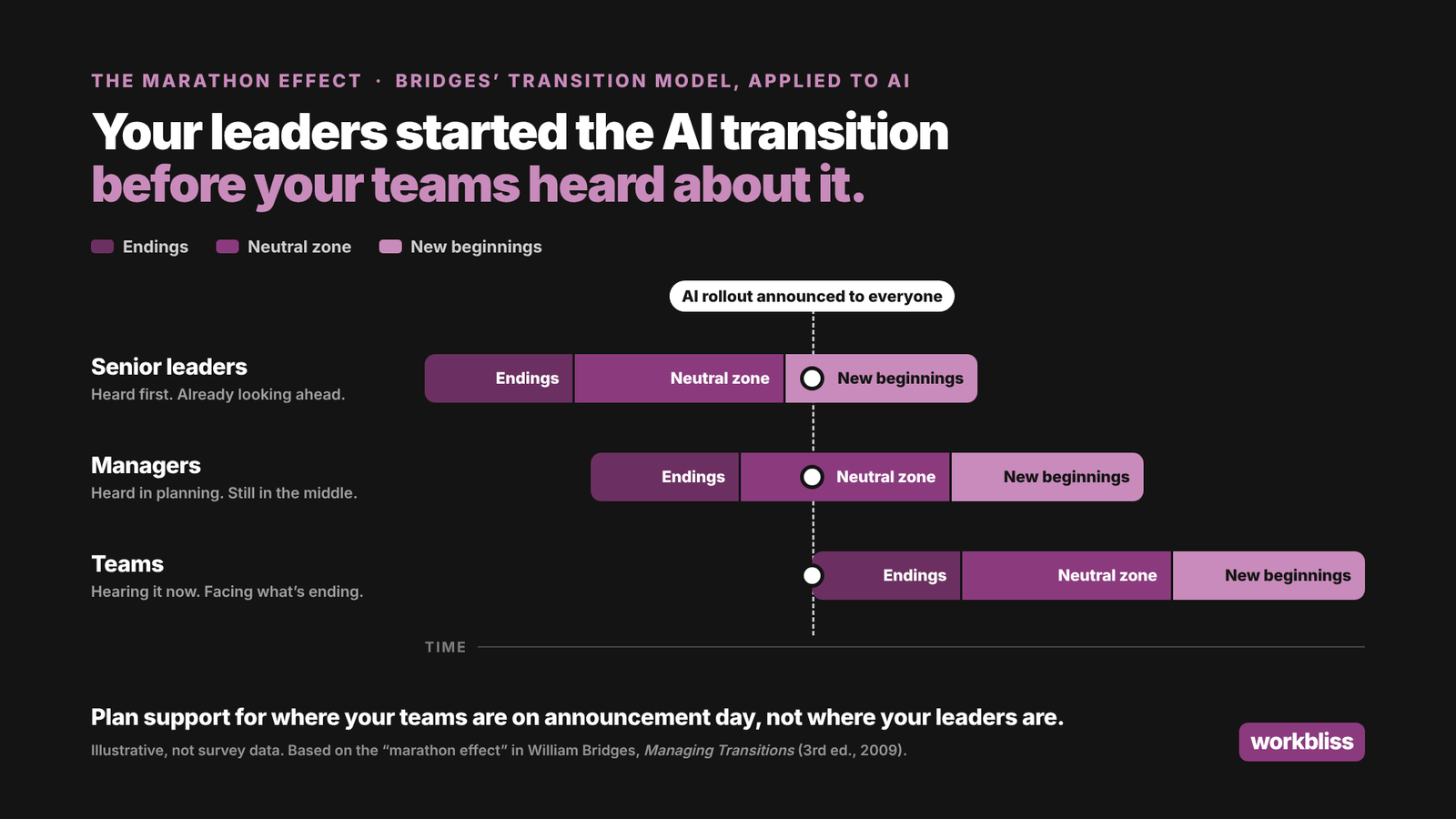
One reason the neutral zone gets rushed is what Bridges called the marathon effect. Like the front runners in a big race, senior leaders set off first. They knew about the change early, so by the time an AI rollout is announced, many have already worked through their own ending. Their teams are only just starting. That gap can make teams' questions look like resistance, when they are simply earlier in the same journey.
New beginnings: making the new way stick
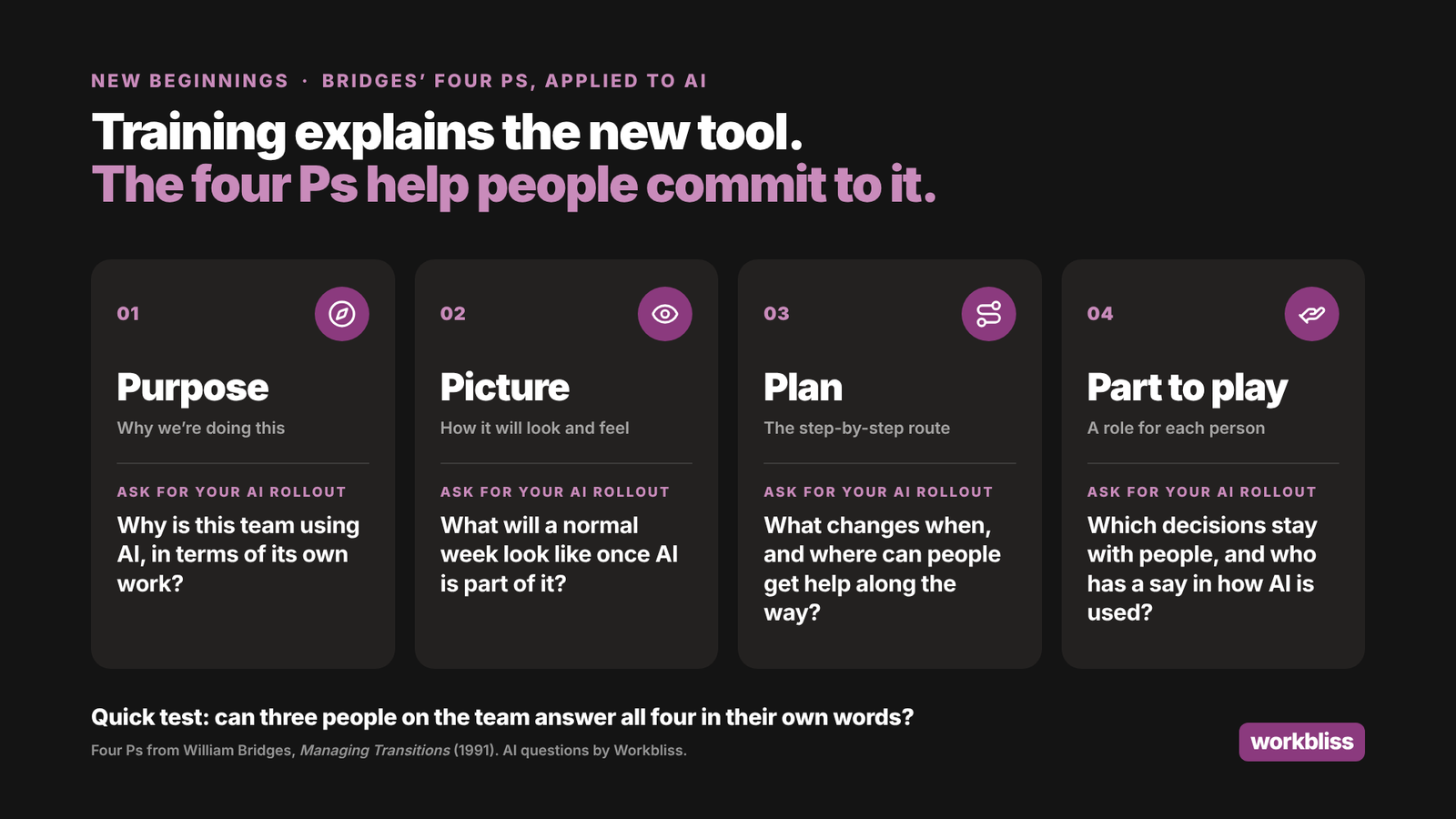
A new beginning is when the new way of working starts to feel normal. A launch date can't force it, but HR and leaders can prepare the ground for it. Bridges suggested four things people need, often called the four Ps:
- Purpose: "Explain the purpose behind the outcome you seek." For AI, that means why this team is using it, in terms of its own work, not only company-wide efficiency.
- Picture: "Paint a picture of how the outcome will look and feel." What will a normal week look like once AI is part of it?
- Plan: "Lay out a step-by-step plan for phasing in the outcome." What changes when, and where can people get help along the way?
- Part to play: "Give each person a part to play in both the plan and the outcome." Which decisions stay with people, and who has a say in how AI is used on the team?
A quick test: ask three people on a team to answer all four in their own words. Where the answers are vague, there's a gap in support, not a gap in willingness.
Early wins matter here too. When people see a colleague save real time on a task they recognize, the new way becomes believable.
Five questions HR can ask about any AI rollout
These questions are Workbliss's way of putting Bridges' model to work. They're useful before launch and again a few months in.
- What exactly is ending for each team, and have we said so out loud?
- What are people worried about losing: skills, status, control, or simply a way of working they enjoy?
- What temporary support is in place for the months when work feels slower?
- Can people describe the purpose, the picture, the plan and their own part, in their own words?
- Where is each group in the transition right now: leaders, managers and teams?
Where Workbliss fits
Workbliss designs the people side of AI change. Our programs help HR teams plan for every phase of the transition, not only the launch. That includes workshops that help teams name what's changing and what's staying, manager sessions on leading people through the neutral zone, and learning programs that build confidence with AI in the context of each team's real work.
Because Workbliss runs programs in 48 countries and territories, global companies can keep one consistent message everywhere while each team gets support that fits how it works. The Workbliss platform, coming soon, will bring these programs together in one place.
Planning the people side of your AI rollout?
Tell us about your teams and your timeline, and we'll suggest a program that fits.
Frequently asked questions
What is the Bridges Transition Model?
The Bridges Transition Model, set out by William Bridges in Managing Transitions (1991), describes the psychological process people go through when something changes at work. It has three phases: endings, when people let go of the old way; the neutral zone, an uncertain in-between period; and new beginnings, when people commit to the new way.
How is the Bridges model different from Lewin's or Kotter's?
The unfreeze, change, refreeze model commonly attributed to Kurt Lewin, and John Kotter's eight steps, mainly describe how an organization moves through a change. Bridges focuses on what happens inside people as they go through it. The models work well together: one for the change plan, Bridges for the transition plan.
What is the marathon effect in change management?
The marathon effect is Bridges' term for how different groups move through a change at different times. Leaders usually learn about a change first, so they're often well into their own transition by the time it's announced. Their teams start later. Without planning for that gap, leaders can expect people to be ready for the new way before they've had time to let go of the old one.
Why does AI change management need a transition plan?
Switching on an AI tool doesn't change how people work. Adoption depends on people letting go of familiar methods, getting through a slower learning period and seeing a clear place for themselves in the new way of working. Gallup's 2026 data suggests that a preference for current methods holds back more non-users than a lack of skills does.
Sources
- William Bridges, Managing Transitions: Making the Most of Change (Addison-Wesley, 1991).
- William Bridges, Managing Transitions: Making the Most of Change, 3rd ed. (Da Capo Press, 2009).
- Andy Kemp, "AI in the Workplace: What Separates Adopters and Holdouts," Gallup, April 12, 2026. Survey of 23,717 employed U.S. adults, February 4–19, 2026. https://www.gallup.com/workplace/704252/workplace-separates-adopters-holdouts.aspx
- John P. Kotter, "Leading Change: Why Transformation Efforts Fail," Harvard Business Review, March–April 1995.
- Kurt Lewin, "Frontiers in Group Dynamics," Human Relations, 1947.