In short
AI transformation is often run as a technology project. Sociotechnical systems theory, which began with a 1951 study of British coal mines, shows why that's only half the job: new technology delivers when the technology and the way work is organized are designed together. Roles, skills, teams and incentives are HR's territory. That makes HR a natural co-designer of AI transformation, not only the team that runs the training.
What is HR's role in AI transformation?
HR's involvement in AI decisions varies widely. In SHRM's State of AI in HR 2026 report, based on a survey of 1,908 HR professionals, more than half of organizations (52%) did not involve HR in AI strategy or vision.
Yet the factor most strongly linked to value from AI is a question about people and work. In McKinsey's March 2025 State of AI survey, out of 25 attributes tested, the redesign of workflows had the biggest effect on an organization's ability to see EBIT impact from its use of gen AI. Only 21% of respondents whose organizations used gen AI said their organizations had fundamentally redesigned at least some workflows.
Redesigning workflows means deciding who does what, with which skills, in which teams and with which incentives. That's work design, and HR is well placed to lead it alongside technology and operations teams.
What is sociotechnical systems theory?
Sociotechnical systems theory came out of the Tavistock Institute in London after World War II. Its core idea is simple: every workplace is both a technical system (tools, equipment and processes) and a social system (people, roles, relationships and skills). Performance depends on how well the two fit together.
Eric Trist, one of the theory's founders, put it this way: "Attempts to optimize for either the technical or social system alone will result in the suboptimization of the socio-technical whole." The goal is what the Tavistock researchers called "joint optimization" of the social and technical systems.
The coal mine story
In 1951, Eric Trist and Ken Bamforth published a study of British coal mining after the introduction of the mechanized "longwall" method.
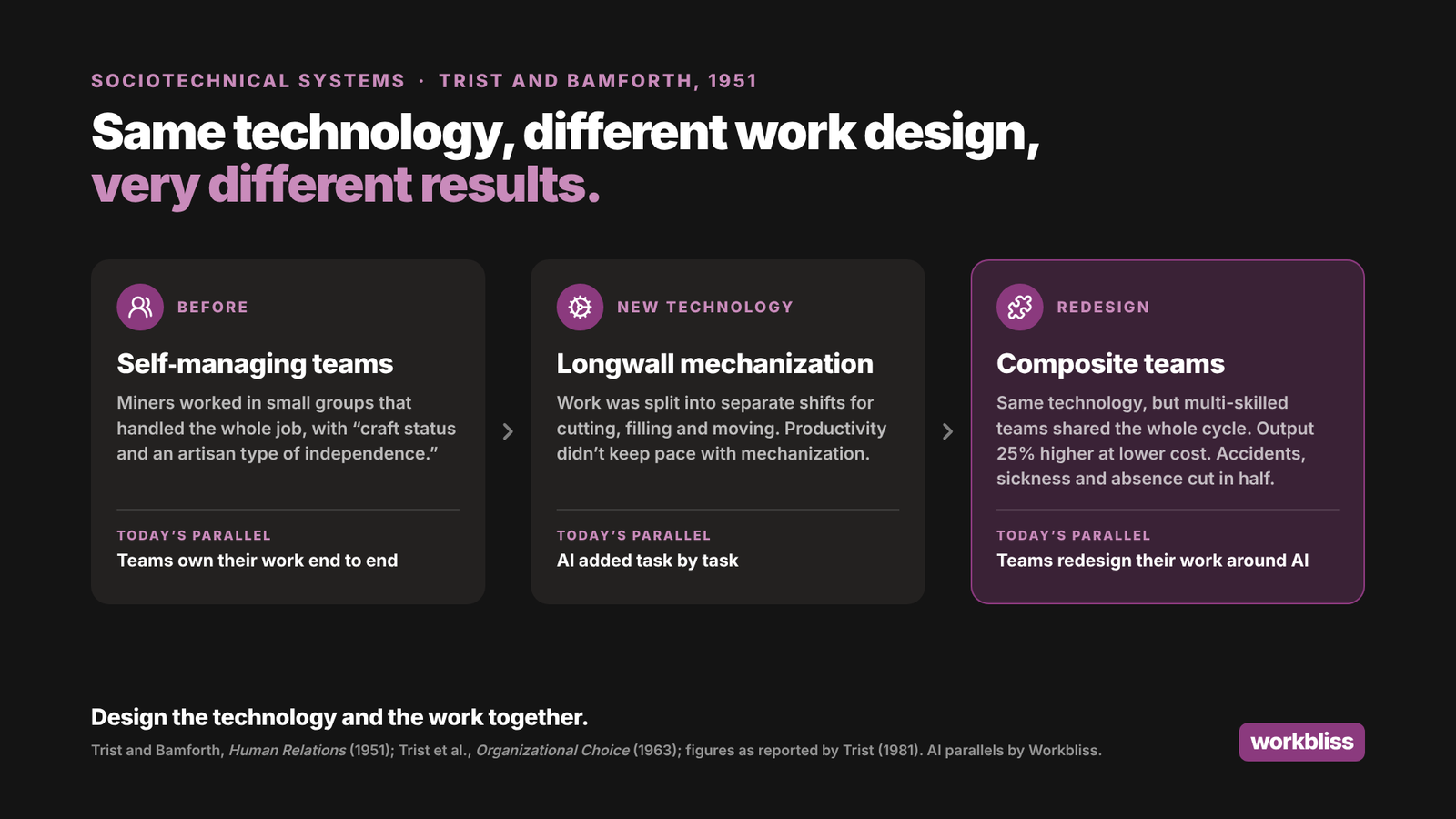
Before mechanization, miners worked in small groups that handled the whole job. Trist and Bamforth described these groups as having "craft status and an artisan type of independence."
The longwall method brought in new machinery and split the work into separate shifts for cutting, filling and moving. Each shift did one part of the cycle, and no group owned the whole task. Trist and Bamforth documented the strain this created, including defensive patterns they called informal organization, reactive individualism, mutual scapegoating and self-compensatory absenteeism. Across the industry, as Trist later recalled, "productivity failed to increase in step with increases in mechanization."
Then came the twist. At some pits, the same longwall technology was organized differently, using "composite" teams: multi-skilled groups that shared the whole cycle across shifts and rotated jobs. In Organizational Choice (1963), Trist and colleagues compared this way of working with the conventional one. As Trist later summarized it, "Output was 25 percent higher with lower costs than on a comparison face similar in every respect (conditions, equipment, personnel) except that of work organization." Accidents, sickness and absenteeism were cut in half.
Same technology. Different work design. Very different results.
Why the coal mine matters for AI
The parallel with AI is close. AI can be added task by task, around existing roles, leaving the way work is organized unchanged. Or teams can redesign their work around it, deciding together which tasks AI takes on, how roles change, which skills are needed and how the team shares responsibility.
The coal mine lesson suggests the second approach is where the bigger gains are. McKinsey's finding on workflow redesign, seven decades later, points the same way.
Five sociotechnical design principles for AI-era work
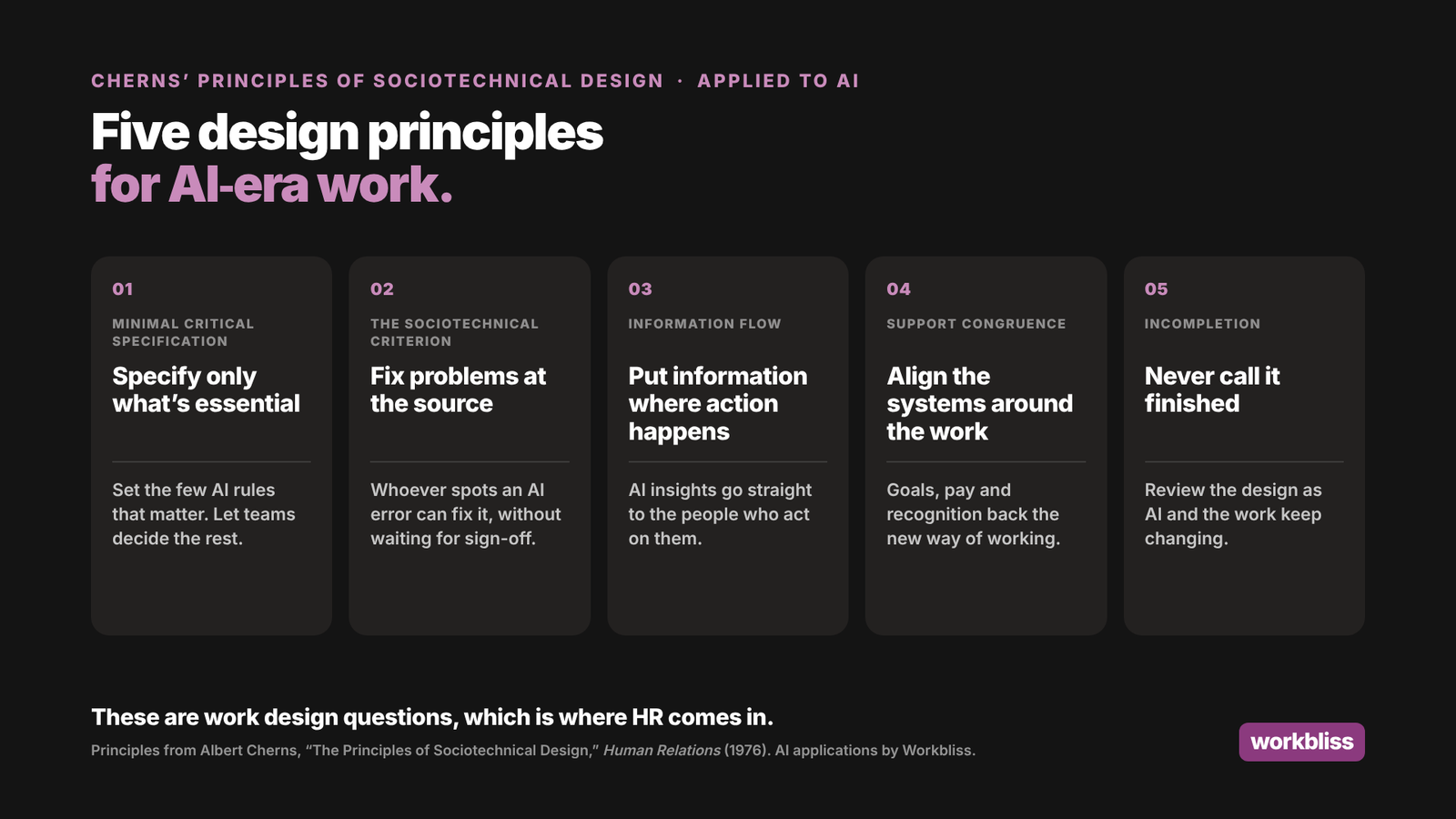
In 1976, the British social scientist Albert Cherns set out nine principles of sociotechnical design. Five of them translate directly to AI:
- Minimal critical specification. Specify only what's essential. Set the few AI rules that really matter, such as data and quality standards, and let teams work out the rest.
- The sociotechnical criterion. Problems should be dealt with as close as possible to where they arise. The people who spot an AI error should be able to fix it without waiting for sign-off.
- Information flow. In Cherns' words, "Information must go, in the first instance, to the place where it is needed for action." AI insights should go to the people who act on them, not only to a central dashboard.
- Support congruence. The systems around the work, such as goals, pay and recognition, should support the new way of working rather than the old one.
- Incompletion. Design is never finished. Review it regularly as AI and the work keep changing.
What HR brings to AI transformation
| What AI transformation needs | What HR already does |
|---|---|
| Redesigned roles and responsibilities | Job design and job architecture |
| New skills, built in the flow of work | Learning and development |
| Teams organized around new workflows | Organization design |
| Goals and rewards that fit the new way of working | Performance management, reward and recognition |
| Support through the transition | Change management, wellbeing and employee experience |
| A voice for the people doing the work | Employee listening and engagement |
How HR can take a design role in AI transformation
- Ask to co-own workflow redesign, not only training. Frame it as joint optimization: the technology and the work designed together.
- Bring the people who do the work into the design. The composite teams grew out of the miners' own way of organizing their work.
- Start with one team, end to end. Redesign tasks, roles, skills and measures together, then share what you learn.
- Check that the support systems match. Make sure goals, performance reviews and recognition reward the new way of working.
- Schedule the next design review. Agree when the team will look at the design again, because AI and the work will keep changing.
These are Workbliss's recommendations based on sociotechnical research, not findings of the studies themselves.
Where Workbliss fits
Workbliss helps HR teams take a design role in AI transformation. Our programs include team workshops that redesign work around AI with the people who do it, manager programs on leading redesigned teams, and learning programs that build skills in the flow of real work.
Because Workbliss runs programs in 48 countries and territories, global companies can redesign consistently while each team shapes the details. The Workbliss platform, coming soon, will bring these programs together in one place.
Ready to put people at the center of your AI transformation?
Tell us about your teams and your goals, and we'll suggest a program that fits.
Related reading: AI and Company Culture: Why Many Employees Keep Their AI Use Quiet
Frequently asked questions
What is a sociotechnical system?
A sociotechnical system is a way of seeing a workplace as two linked systems: the technical system of tools and processes, and the social system of people, roles and relationships. The theory, developed at London's Tavistock Institute in the early 1950s, holds that the two must be designed together.
What did Trist and Bamforth find?
Studying British coal mines in 1951, Eric Trist and Ken Bamforth found that the mechanized longwall method split the work into separate specialist shifts and broke up the small, self-managing groups miners had worked in. The result was strain, defensive behavior and absenteeism. Later research showed that multi-skilled "composite" teams using the same technology performed much better.
What is HR's role in AI transformation?
HR's role is to make sure the work is redesigned alongside the technology: roles, skills, team structures, incentives and support through the change. Sociotechnical research, and recent survey data on the value of workflow redesign, suggest these people factors shape how much value AI delivers.
What is joint optimization?
Joint optimization is the sociotechnical principle that the social and technical systems of work should be designed together. As Eric Trist put it, optimizing for either one alone "will result in the suboptimization of the socio-technical whole."
Sources
- E. L. Trist and K. W. Bamforth, "Some Social and Psychological Consequences of the Longwall Method of Coal-Getting," Human Relations 4, no. 1 (1951): 3–38. https://doi.org/10.1177/001872675100400101
- E. L. Trist, G. W. Higgin, H. Murray and A. B. Pollock, Organizational Choice: Capabilities of Groups at the Coal Face under Changing Technologies (London: Tavistock Publications, 1963).
- Eric Trist, The Evolution of Socio-Technical Systems: A Conceptual Framework and an Action Research Program, Occasional Paper No. 2, Ontario Quality of Working Life Centre, 1981.
- Albert Cherns, "The Principles of Sociotechnical Design," Human Relations 29, no. 8 (1976): 783–792. https://doi.org/10.1177/001872677602900806
- Alex Singla, Alexander Sukharevsky, Lareina Yee and Michael Chui, with Bryce Hall, "The State of AI: How Organizations Are Rewiring to Capture Value," McKinsey & Company, March 12, 2025. https://www.mckinsey.com/capabilities/quantumblack/our-insights/the-state-of-ai-how-organizations-are-rewiring-to-capture-value
- SHRM, State of AI in HR 2026, March 31, 2026. https://www.shrm.org/executive-network/insights/state-of-ai-hr-2026-5-critical-insights-chros