In short
A lot of AI use at work happens out of sight. In Deloitte's 2026 survey of 25,000 UK workers, 31% of people who use generative AI for work said they use it without their employer knowing. Company policy is rarely the whole story. Edgar Schein's three levels of culture help explain why: AI tools and policies sit on the visible surface, but behavior is shaped by deeper assumptions about what counts as real work, who gets credit and what AI means for people's jobs. HR can shape those assumptions through what leaders measure, reward and model.
How does company culture affect AI adoption?
A large new survey shows how much AI use happens out of sight, and why.
Deloitte's GenAI Workforce Survey asked 25,000 UK workers about generative AI between May and June 2026. 63% said they use it for work. Of those, 31% said they use it without their employer's knowledge.
The reasons point below the surface. 64% of weekly users worry that their manager will think AI can do their job, and 23% of all workers believe there's a stigma attached to using AI at work. Deloitte UK's chief AI officer, Hayley McKelvey, put it plainly: "Workers who feel a stigma around adopting GenAI tools are more likely to conceal their use."
The visible signals are weak, too. 65% of AI users don't hear their leaders talk about AI with a clear understanding of it. And only 28% say their company has an AI policy and they know where it is.
In other words, the biggest barriers aren't written rules. They're unwritten ones, and the written ones are often hard to find. That's exactly the territory Edgar Schein's model of culture describes.
What are Schein's three levels of culture?
Edgar Schein, a long-time professor at MIT's Sloan School of Management, set out his model in Organizational Culture and Leadership, first published in 1985. He defined culture as a pattern of basic assumptions that a group develops as it learns to deal with its problems, and that has worked well enough to be taught to new members as "the correct way to perceive, think, and feel in relation to those problems."
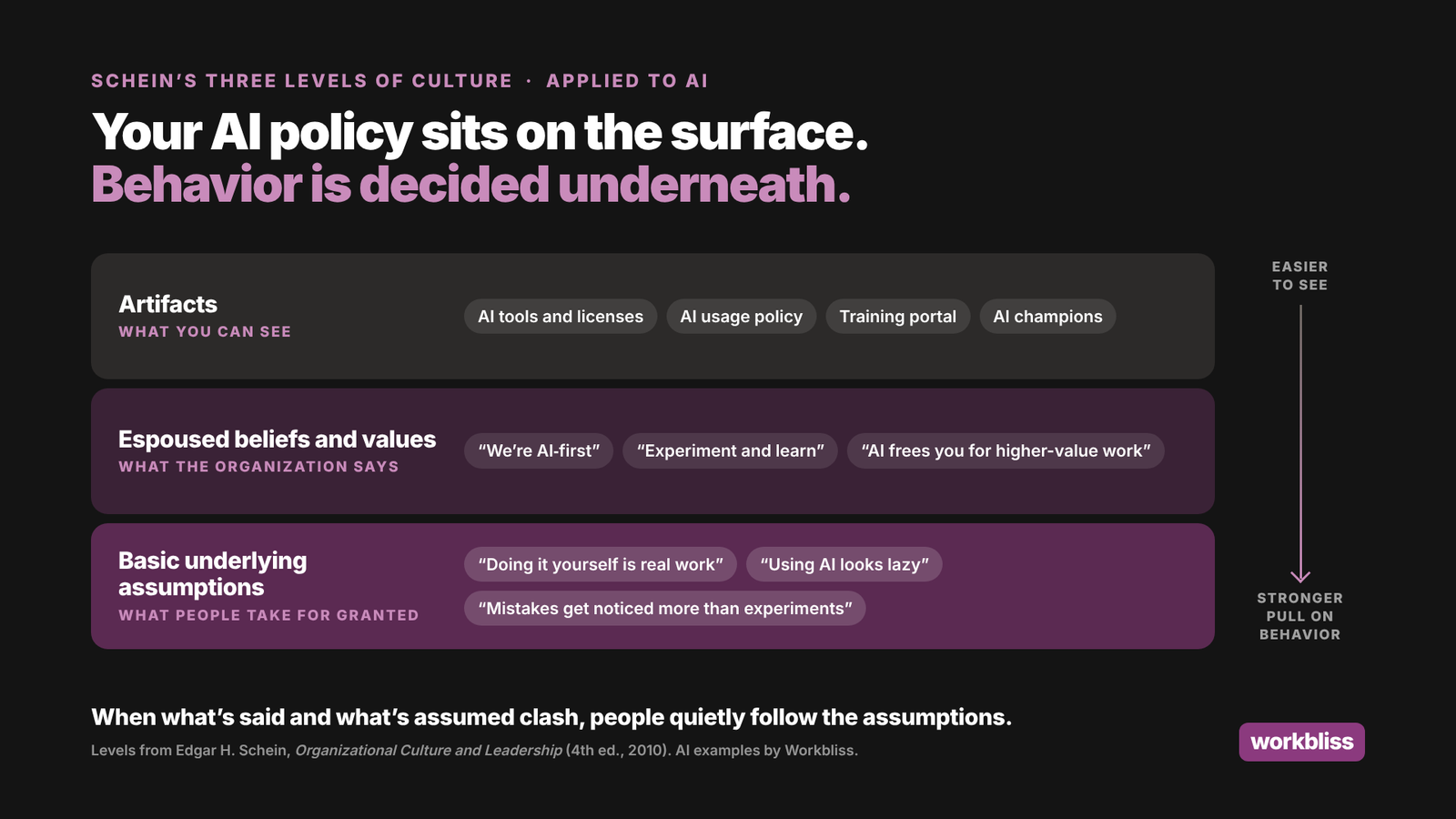
He described culture at three levels:
| Level | What it is | AI example | How visible it is |
|---|---|---|---|
| Artifacts | What you can see and hear: structures, processes, tools and language | AI licenses, an AI usage policy, a training portal, AI champions | Easy to see, but hard to interpret on its own |
| Espoused beliefs and values | What the organization says it believes and aims for | "We're AI-first." "Experiment and learn." | Stated openly in strategies, town halls and company values |
| Basic underlying assumptions | Unspoken beliefs that people take for granted | "Doing it yourself is real work." "If AI can do this, what am I for?" | Rarely said out loud, but they shape what people actually do |
Where AI culture gets stuck
AI programs naturally start with the top two levels. They add tools, write policies and explain why AI matters. Those steps are necessary. But when the message clashes with the assumptions underneath, people tend to follow the assumptions, often quietly.
That's what the hidden-use data suggests. An organization can say "use AI" while people still assume that real professionals do the work themselves, or that showing what AI can do puts their own job at risk. The result isn't open resistance. It's AI use that happens out of sight, where nobody can learn from it, check it or share what works.
Sometimes even the stated message is thin. In Gallup's latest U.S. data, 49% of employees say their organization has integrated AI, but only 26% say it has communicated a clear plan.
Assumptions about job security matter too. Gallup found that workers who use AI frequently are more than twice as likely as less frequent users to fear their job will be eliminated within five years. But among people who feel their organization cares about their wellbeing, that link was much weaker. How people are treated shapes how AI feels.
Six ways leaders shape AI culture, according to Schein
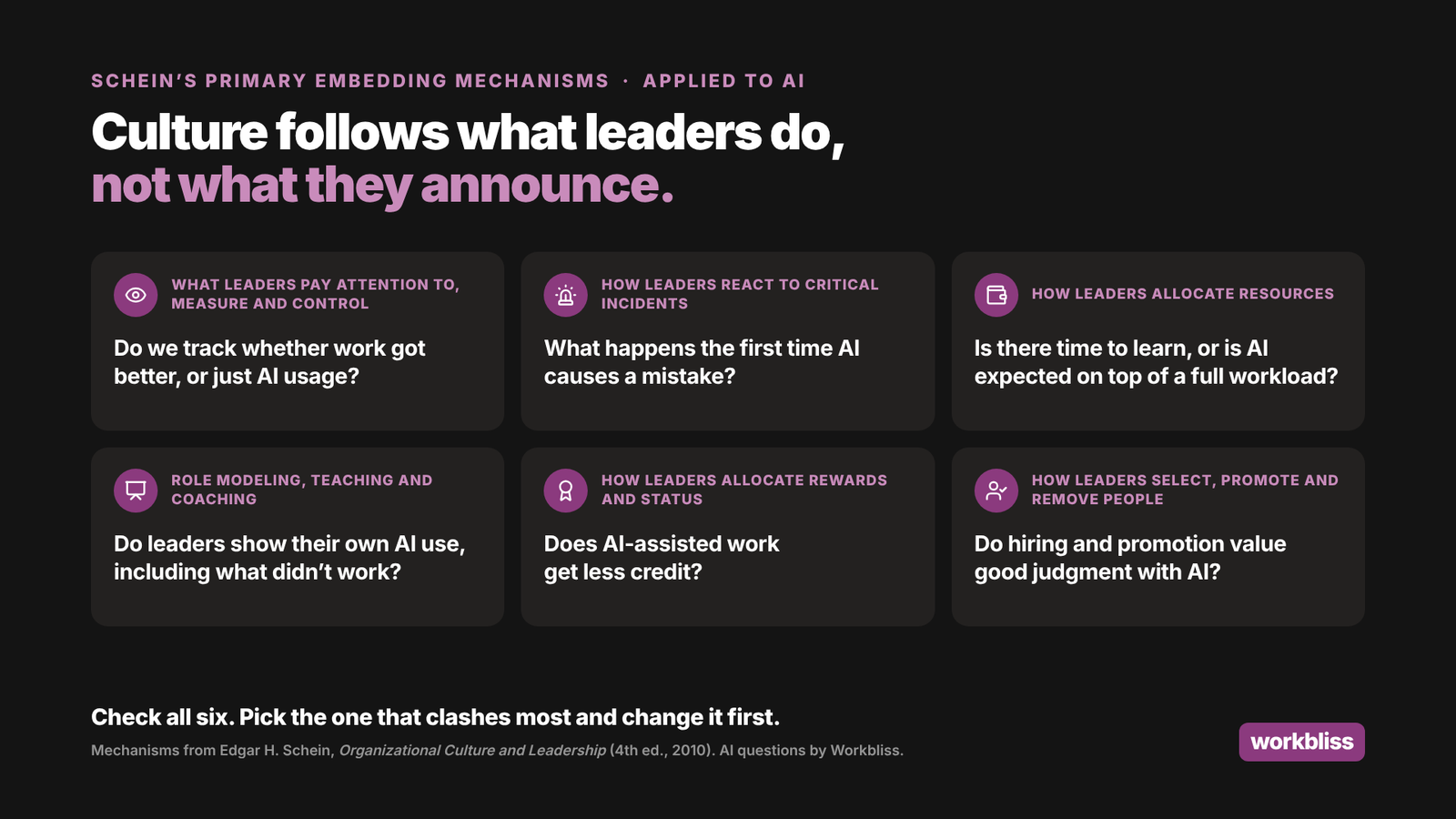
Schein argued that leaders embed culture less through what they announce than through what they do. In later editions of his book, he named six "primary embedding mechanisms." Each one sends a signal about AI:
- What leaders pay attention to, measure and control. If dashboards only track usage, people learn that usage is what matters, not better work.
- How leaders react to critical incidents. The first time AI contributes to a visible mistake, the response tells everyone whether experimenting is safe.
- How leaders allocate resources. Time and budget to learn signal that AI is a priority. AI added on top of a full workload signals the opposite.
- Deliberate role modeling, teaching and coaching. Leaders who show their own AI use, including what didn't work, make it normal to talk about.
- How leaders allocate rewards and status. If AI-assisted work gets less credit, people will hide it.
- How leaders select, promote and remove people. Hiring and promotion criteria show which skills really count, including good judgment with AI.
What HR can do
- Listen for the assumptions. Add a question to pulse surveys or team sessions, such as "Would you feel comfortable telling your manager you used AI for this?" The answers show where the unwritten rules are.
- Make AI use something people can talk about. Agree simple norms for saying when AI helped, and make sure saying so never costs anyone credit.
- Talk about what AI means for roles. One-on-one conversations about how someone's work is changing, and which skills still matter, do more than a company-wide announcement.
- Make the policy easy to find and easy to read. If people can't find it, it can't reassure them.
- Plan the first-mistake response in advance. Decide with leaders how AI-related errors will be handled, so the first one becomes a learning moment rather than a warning.
- Give people time. Build learning time into workloads rather than adding AI on top.
- Update recognition and promotion criteria. Include good judgment with AI, such as knowing when not to use it.
These are Workbliss's recommendations based on Schein's model and the research above.
Where Workbliss fits
Workbliss helps HR teams work on the culture underneath AI, not just the tools on top. Our programs include team workshops that surface the unspoken rules about AI, leadership and manager programs on role modeling and responding well when things go wrong, wellbeing programs that help people feel secure while their work changes, and learning programs that give people practical confidence with AI in their own work.
Because Workbliss runs programs in 48 countries and territories, global companies can build one consistent AI culture while respecting how teams work locally. The Workbliss platform, coming soon, will bring these programs together in one place.
Building an AI culture people don't have to hide?
Tell us about your teams and your goals, and we'll suggest a program that fits.
Related reading: AI ROI: Why AI Productivity Often Dips Before It Rises
Frequently asked questions
What are Schein's three levels of culture?
Edgar Schein described organizational culture at three levels: artifacts, the visible structures, processes and tools; espoused beliefs and values, what the organization says it believes; and basic underlying assumptions, the unspoken beliefs people take for granted. The deepest level has the strongest influence on how people actually behave.
Why do employees hide their use of AI at work?
Surveys suggest the main reasons are cultural rather than about policy. In Deloitte's 2026 survey of 25,000 UK workers, 64% of weekly AI users worried their manager would think AI could do their job, and 23% of workers saw a stigma in using AI at work. Only 28% of AI users said their company had an AI policy and they knew where it was.
How can leaders build a culture that supports AI?
According to Schein, leaders shape culture mainly through what they pay attention to and measure, how they react to mistakes, how they allocate resources, rewards and status, what they model themselves, and whom they hire and promote. Aligning these with the AI message matters more than the message itself.
What's the difference between an AI policy and an AI culture?
An AI policy is an artifact: a visible, written set of rules. AI culture is what people actually believe and do about AI, including unspoken assumptions about credit, competence and job security. A policy can encourage AI use while the culture quietly discourages it.
Sources
- Edgar H. Schein, Organizational Culture and Leadership (San Francisco: Jossey-Bass, 1985; 4th ed., 2010).
- Edgar H. Schein, "Organizational Culture," American Psychologist 45, no. 2 (1990): 109–119.
- Deloitte UK, "British workers spend nearly £1bn of their own money on GenAI for work," September 16, 2026. GenAI Workforce Survey of 25,000 UK workers aged 18 to 70, conducted by Ipsos UK, May 7 to June 10, 2026. https://www.deloitte.com/uk/en/about/press-room/british-workers-spend-one-billion-pounds-of-their-own-money-on-gen-ai-for-work.html
- Deloitte UK, "GenAI Workforce Survey: Leadership and training." https://www.deloitte.com/uk/en/issues/generative-ai/genai-workforce-survey-leadership-training.html
- Gallup, "Artificial Intelligence" indicator, data through August 2026. https://www.gallup.com/699797/indicator-artificial-intelligence.aspx
- Christos Makridis, "Using AI More Does Not Reassure Workers, Managers Do," Gallup, September 9, 2026. https://www.gallup.com/workplace/713231/ai-not-reassure-workers-managers-do.aspx