In short
International Stress Awareness Week runs from Monday, November 2, to Friday, November 6, 2026. This year's theme from the International Stress Management Association (ISMA UK) is "Shaping the Future of Stress and Wellbeing: Rehumanising the Workplace."
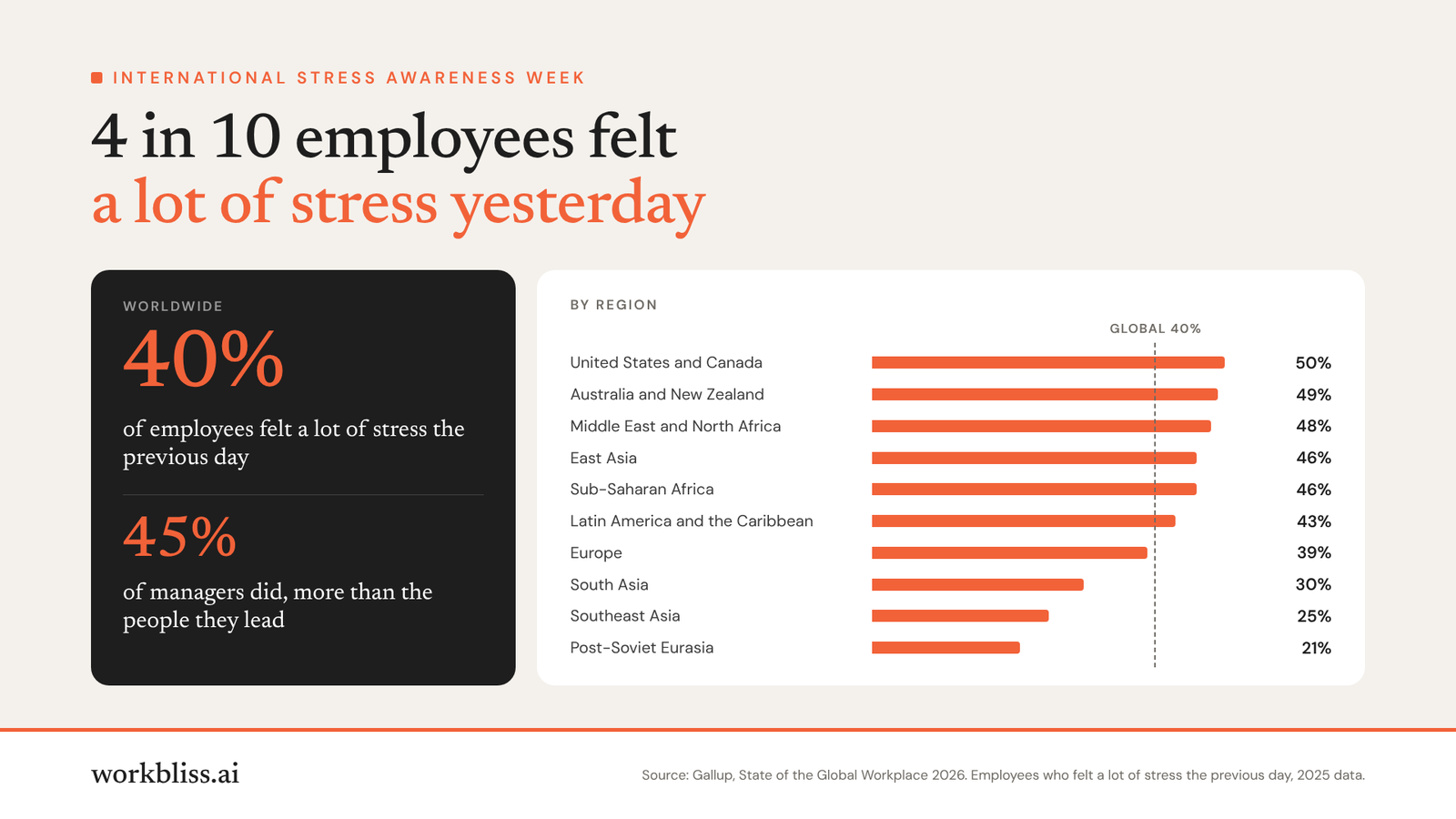
Stress is part of working life. In Gallup's State of the Global Workplace 2026 report, 4 in 10 employees worldwide said they felt a lot of stress the day before they were surveyed, and managers were more stressed than the people they lead.
The aim isn't a stress-free workplace. It's catching stress early, before it builds up. So the most useful Stress Awareness Week is built around prevention. It helps people spot stress early, gives managers the skills to lighten the load on their teams, looks at how work gets done, and builds habits that last well past Friday.
Why prevention is the opportunity
- 40% of employees worldwide experienced a lot of stress the previous day, according to Gallup's State of the Global Workplace 2026 report. For managers, it was 45%.
- Stress varies a lot by region, from 50% in the United States and Canada and 39% in Europe to 30% in South Asia and 25% in Southeast Asia. One message won't land the same way in every office.
- In Great Britain, 964,000 workers reported stress, depression or anxiety caused or made worse by work in 2024/25, and 22.1 million working days were lost to it, according to the Health and Safety Executive.
- Worldwide, the World Health Organization estimates that 12 billion working days are lost every year to depression and anxiety.
Not all stress becomes a problem. The WHO describes burnout as the result of chronic workplace stress "that has not been successfully managed." That's where prevention comes in: the earlier stress is noticed and managed, the less chance it has to build.
The WHO also points employers to three kinds of action: improving working conditions, training managers, and helping people build the skills to manage stress. A good Stress Awareness Week touches all three.
How to bring Stress Awareness Week to life at work
1. Pick your format
The week runs Monday to Friday, so you can run one session a day, hold everything on one day, or launch during the week and carry it through November. If your offices span time zones, run each session more than once, so nobody has to join at midnight.
2. Start with awareness
Most people know what stress feels like, but fewer spot the early signs, like poor sleep, a short fuse or trouble focusing. A short awareness session explains what stress is, how it shows up and what helps, in plain words. Keep it practical, and leave diagnosis to professionals.
3. Help everyone make a personal plan
Stress shows up differently for everyone, so a one-size-fits-all tip sheet only goes so far. Give people time to map what drains them, what restores them and one small change they'll try the next week. Include sleep: stress and poor sleep tend to feed each other, so a session on sleep habits is one of the most useful things you can offer.
4. Equip your managers
Managers set the pace for their teams, and in Gallup's data they're more stressed than the people they lead. Training helps them spot stress early, have supportive conversations, and manage workload and priorities. The WHO recommends manager training as one of the ways employers can support mental health at work.
5. Look at the work itself
Some of the best ideas are free. Ask each team to cut or shorten one recurring meeting for the week, protect a block of focus time, or agree on when people are expected to answer messages, especially across time zones. Small changes to how work gets done show people the week is about more than a poster.
6. Give people a moment to reset
This year's theme is about rehumanising the workplace, and that can be as simple as a break that feels good. A chair massage day, an aromatherapy workshop or a no-agenda coffee hour, where the only rule is no work talk, gets people away from their screens and talking to each other.
7. Point people to the support they already have
Stress Awareness Week is a good moment to remind people what's already on offer. Share a one-page guide to your employee assistance program, mental health benefits, leave policies and any wellbeing apps you provide, and ask managers to share it with their teams too.
8. Reach every office
Run sessions in the languages people speak, and at times that work in each region. Give frontline and shift teams their own version, at a time they can actually join, rather than a lunchtime webinar they can't get to.
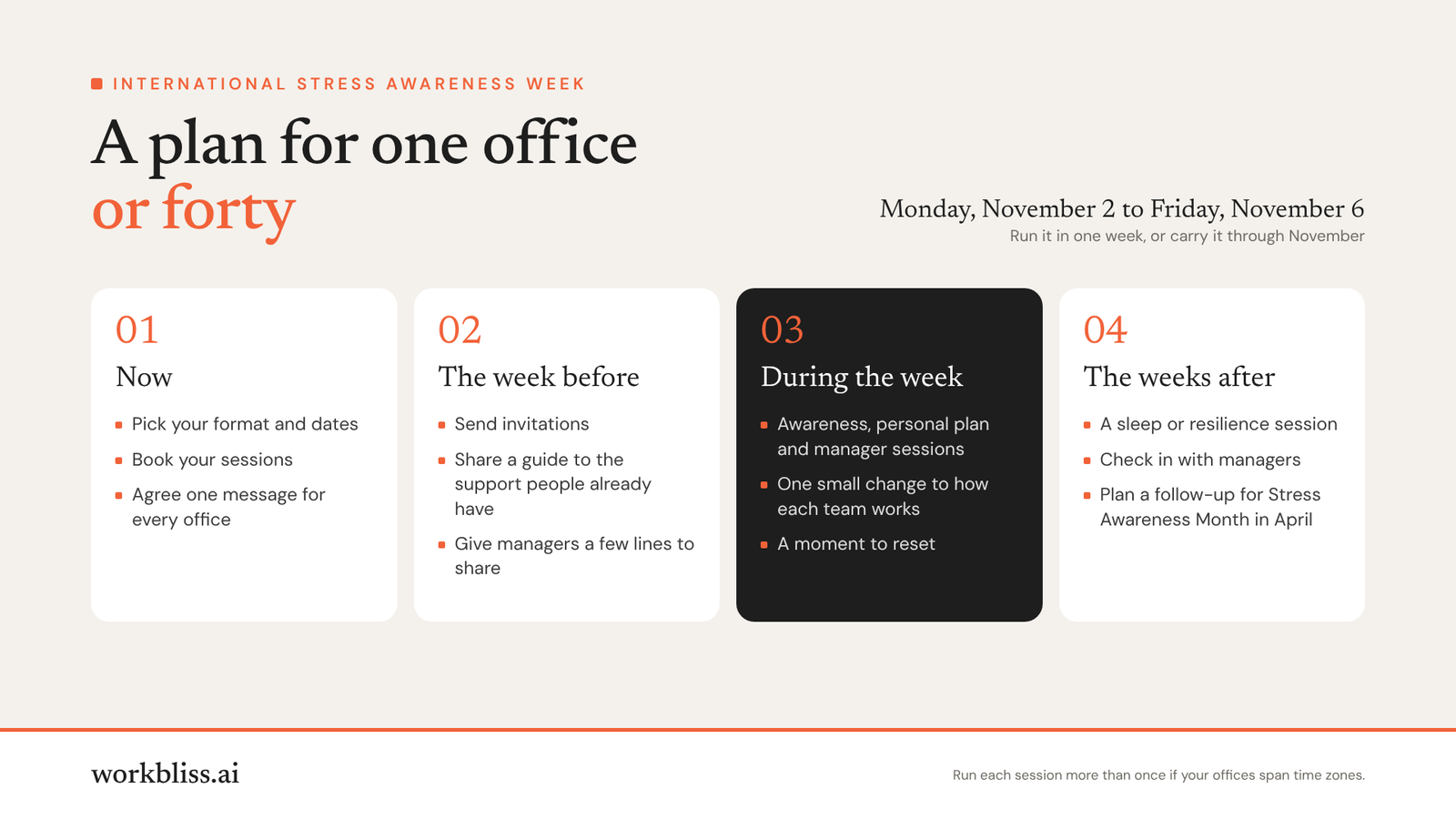
A simple plan for one office or forty
- Now: pick your format and dates, book your sessions, and agree one message for every office.
- The week before: send invitations, share your guide to the support people already have, and give managers two or three lines to share with their teams.
- During the week, November 2 to 6: run the awareness, personal plan and manager sessions; ask each team to make one small change to how they work; and hold a moment to reset.
- The weeks after: run a sleep or resilience session later in November, check in with managers on what they changed, and plan a follow-up for Stress Awareness Month in April.
Where Workbliss fits
Workbliss runs prevention-focused workforce experience programs for global employers, with one plan and one point of contact for every office. For Stress Awareness Week, there are two bundles to choose from.
The Stress Awareness bundle helps people spot stress early, plan their own way through it, sleep better and bounce back. It's four live sessions:
- Effective Stress Management
- Creating a Personal Stress-Reduction Plan
- Sleep Health & Hygiene
- Building Emotional Resilience Through Self-Compassion
Prefer something hands-on? Take three of the sessions plus a chair massage day or an aromatherapy workshop.
The People Manager series gives managers the skills to look after their own energy and lower stress on their teams:
- Manage Your Energy, Not Just Your Time
- Emotional Intelligence for Managers
- Managing Team Burnout and Stress
You can add an aromatherapy workshop or a chair massage day.
Every session runs online or in person, in your people's languages. You can run a bundle in one day, across the week or across the month.
We usually need 14 days' notice. Stress Awareness Week is less than two weeks away, so if you'd like to mark it during the week, email hello@workbliss.ai and we'll see what we can do. Or run your bundle across the rest of November.
See the Stress Awareness bundle
Frequently asked questions
When is International Stress Awareness Week 2026?
International Stress Awareness Week runs from Monday, November 2, to Friday, November 6, 2026. It's run by the International Stress Management Association (ISMA UK).
What is the theme for Stress Awareness Week 2026?
The 2026 theme is "Shaping the Future of Stress and Wellbeing: Rehumanising the Workplace."
What's the difference between stress and burnout?
Stress is the body's response to pressure, and short spells of it are part of life. The WHO describes burnout as a syndrome resulting from chronic workplace stress that has not been successfully managed. It's marked by exhaustion, feeling distant or cynical about work, and feeling less effective at work. The WHO doesn't classify burnout as a medical condition.
How can managers reduce stress on their teams?
Managers can spot early signs, check in regularly, set clear priorities, keep workloads realistic and take breaks themselves, so their teams feel able to as well. Training helps them have supportive conversations and know when to point someone to professional support, such as an employee assistance program.
Do employers have to manage stress at work?
Rules vary by country. In Great Britain, for example, the Health and Safety Executive says employers must manage the risk of work-related stress, by doing a risk assessment and acting on it. Check with your legal or health and safety team for the rules where you operate. Awareness sessions support this work, but they don't replace a risk assessment.
How do you run Stress Awareness Week across global offices?
Agree one message, then adapt it locally. Run sessions in people's languages, at times that work in each time zone, and with examples that fit local working life. Stress levels also differ by region, so expect different questions in different offices.
Is it too late to plan for Stress Awareness Week?
No. Free ideas, like cutting one meeting or sharing a guide to the support people already have, can start right away. Sessions can run during the week or across November. If your date is less than 14 days away, email hello@workbliss.ai and we'll see what we can do.
Sources
- Gallup, "State of the Global Workplace: 2026 Report," April 2026. https://www.gallup.com/workplace/697904/state-of-the-global-workplace-2026.aspx
- Health and Safety Executive, "HSE publishes annual workplace health and safety statistics," November 20, 2025. https://press.hse.gov.uk/?p=7490
- Health and Safety Executive, "Working days lost in Great Britain." https://www.hse.gov.uk/statistics/dayslost.htm
- Health and Safety Executive, "Stress at work." https://www.hse.gov.uk/stress/
- World Health Organization, "Mental health at work," fact sheet. https://www.who.int/news-room/fact-sheets/detail/mental-health-at-work
- World Health Organization, "Burn-out an 'occupational phenomenon': International Classification of Diseases," May 28, 2019. https://www.who.int/news/item/28-05-2019-burn-out-an-occupational-phenomenon-international-classification-of-diseases
- International Stress Management Association (ISMA UK), International Stress Awareness Week 2026. https://isma.org.uk/