In short
National Fertility Awareness Week runs from Monday, November 2, to Friday, November 6, 2026, in the UK. This year it's led by the charity Fertility Action.
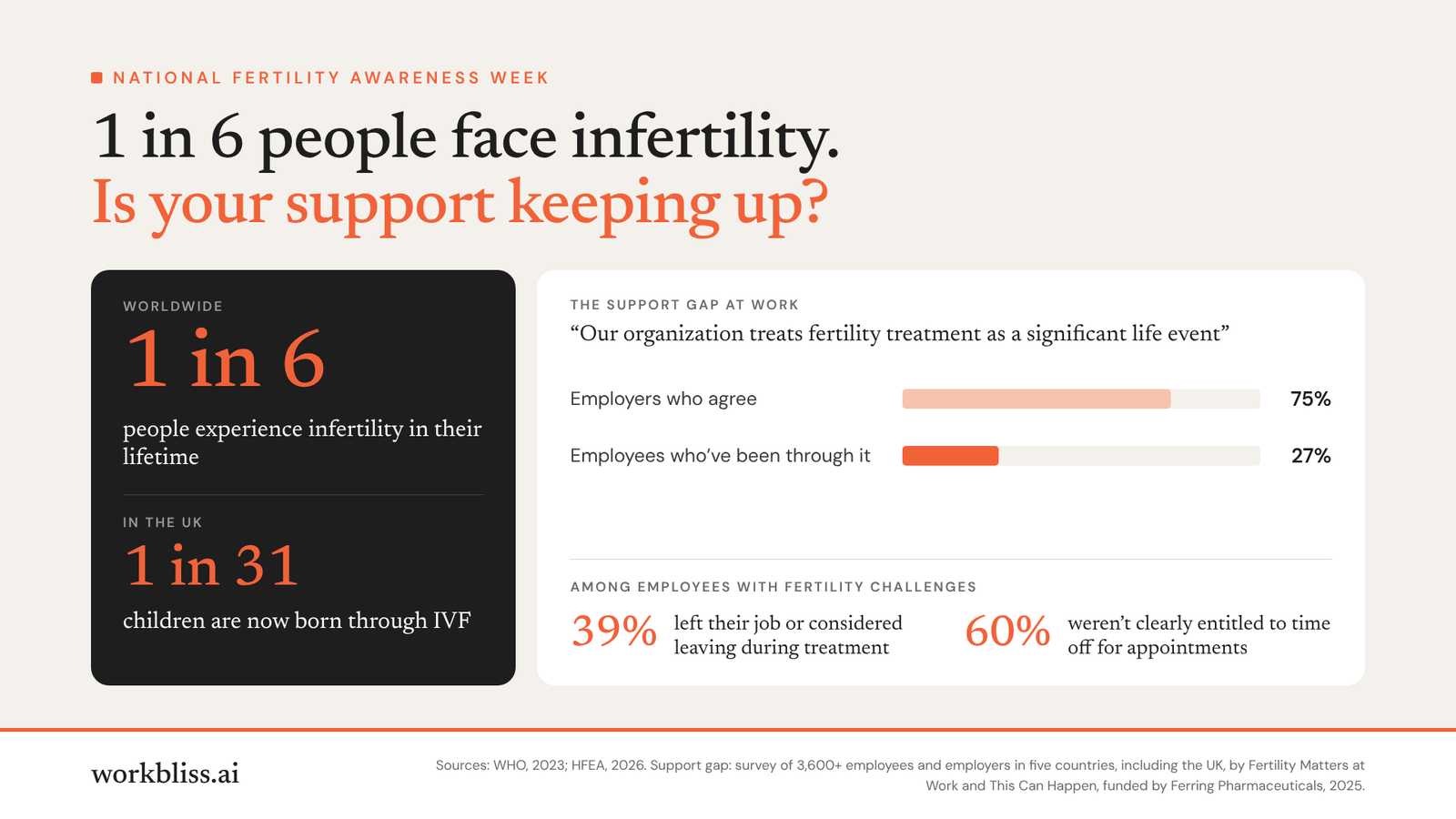
Fertility challenges affect around 1 in 6 people worldwide, according to the World Health Organization, and almost all of them are of working age. In the UK, 53,000 people had IVF in 2024, and about 1 in 31 children are now born through IVF.
Most of those people are fitting treatment around work. In the UK there's no specific legal right to time off for fertility appointments, so what an employer does makes a real difference: its policy, how its managers respond, and whether people feel able to say anything at all.
The week is a good moment to check whether your support matches what people actually need, and to make sure people know it exists.
Why it matters at work
- Around 17.5% of adults, roughly 1 in 6 people worldwide, experience infertility at some point in their lives, according to the WHO. It affects people in every region and income level.
- In the UK, the number of people having IVF has almost tripled in 30 years, from about 19,000 a year in the early 1990s to 53,000 in 2024, according to the Human Fertilisation and Embryology Authority (HFEA).
- The NHS funded 28% of UK IVF cycles in 2024, down from 35% in 2019. The HFEA's chair says almost three quarters of patients now pay for treatment themselves.
- Treatment often takes more than one attempt. In 2024, the average birth rate per embryo transferred was 30%, and much lower for older patients.
The support gap shows up at work. In an international survey of more than 3,600 employees and employers in five countries, including the UK, 39% of employees with fertility challenges had left their job or considered leaving during treatment. 60% said they weren't clearly entitled to time off for appointments.
The same survey found a gap in how employers and employees see things. 75% of employers said their organization treats fertility treatment as a significant life event. Only 27% of employees who'd been through fertility challenges agreed. That survey was run by Fertility Matters at Work and This Can Happen, and funded by Ferring Pharmaceuticals, which makes fertility medicines.
What UK law says, and what's changing
This is a summary, not legal advice. Check with your legal or HR team for your situation.
- There's no specific statutory right to paid or unpaid time off for fertility treatment in the UK. Most people use annual leave, sick leave or informal arrangements with their manager.
- From the point of embryo transfer, employment lawyers say someone having IVF should be treated as pregnant, with the same protection from unfair treatment, until a pregnancy is confirmed or the transfer is unsuccessful. Because IVF often involves several cycles, people can move in and out of that protection.
- Treating fertility appointments less favorably than other medical appointments could risk a sex discrimination claim.
- From April 2027, a new day-one right to up to two weeks' bereavement leave is due to come into force. It covers pregnancy loss before 24 weeks, including an unsuccessful IVF embryo transfer. At the statutory minimum, the leave is unpaid.
- A Private Member's Bill that would give people a right to paid time off for fertility treatment, and extend it to their partners, was introduced in Parliament in November 2025. It hasn't progressed beyond its first reading.
So for now, most of the support people get at work comes from their employer's own policy and their manager.
How to mark National Fertility Awareness Week at work
1. Say it out loud
A short message from a senior leader goes a long way. Acknowledge that fertility challenges affect a lot of people, say who's included, and say where support is. Many people never tell anyone at work, so hearing it named can matter more than any single benefit.
2. Check your policy, or write one
A good fertility policy covers time off for appointments, flexible working, who's included, confidentiality, and what happens after an unsuccessful cycle or a pregnancy loss. Write it for everyone: women and men, same-sex couples, single people, and people using donors or surrogacy. With the new bereavement leave rules due in April 2027, now is a good time to review how your leave policies fit together.
3. Make appointments easier
Fertility appointments are frequent and often booked at short notice, sometimes with only a day or two's warning. Flexible start and finish times, shift swaps, working from home on appointment days and not asking people to explain each absence in detail all help. So does making sure appointment time isn't counted against people in absence reviews.
4. Equip your managers
Most people will tell their manager first, if they tell anyone. Brief managers on how to respond: listen, ask what would help, keep it confidential, and don't assume what someone needs. Make sure they know what the policy says and where to point people. The perception gap in the survey above suggests many organizations think they're more supportive than their people feel.
5. Include partners, and men
Infertility can involve either partner, and partners go through treatment too, from appointments to the emotional strain. Make sure your policy and your messages include them, and that men's health sessions cover fertility as well.
6. Point people to the support they already have
Share a one-page guide to your employee assistance program, counseling, any fertility benefits your health plan includes, and your leave policies. For impartial information on treatment and clinics, point people to the HFEA's website, and for peer support, to fertility charities.
7. Offer an educational session
A session on fertility awareness helps everyone, not just people trying for a baby right now. It can cover how fertility works, the lifestyle factors that affect it for both women and men, and when to seek advice. Keep it educational, led by a qualified health educator, and leave personal medical advice to clinicians.
8. Keep it private, and reach every site
Fertility is personal, so make it easy to take part discreetly: no public sign-up lists, cameras optional in online sessions, and anonymous questions. Run sessions at times shift and frontline teams can join, and in the languages your people speak.
A simple plan
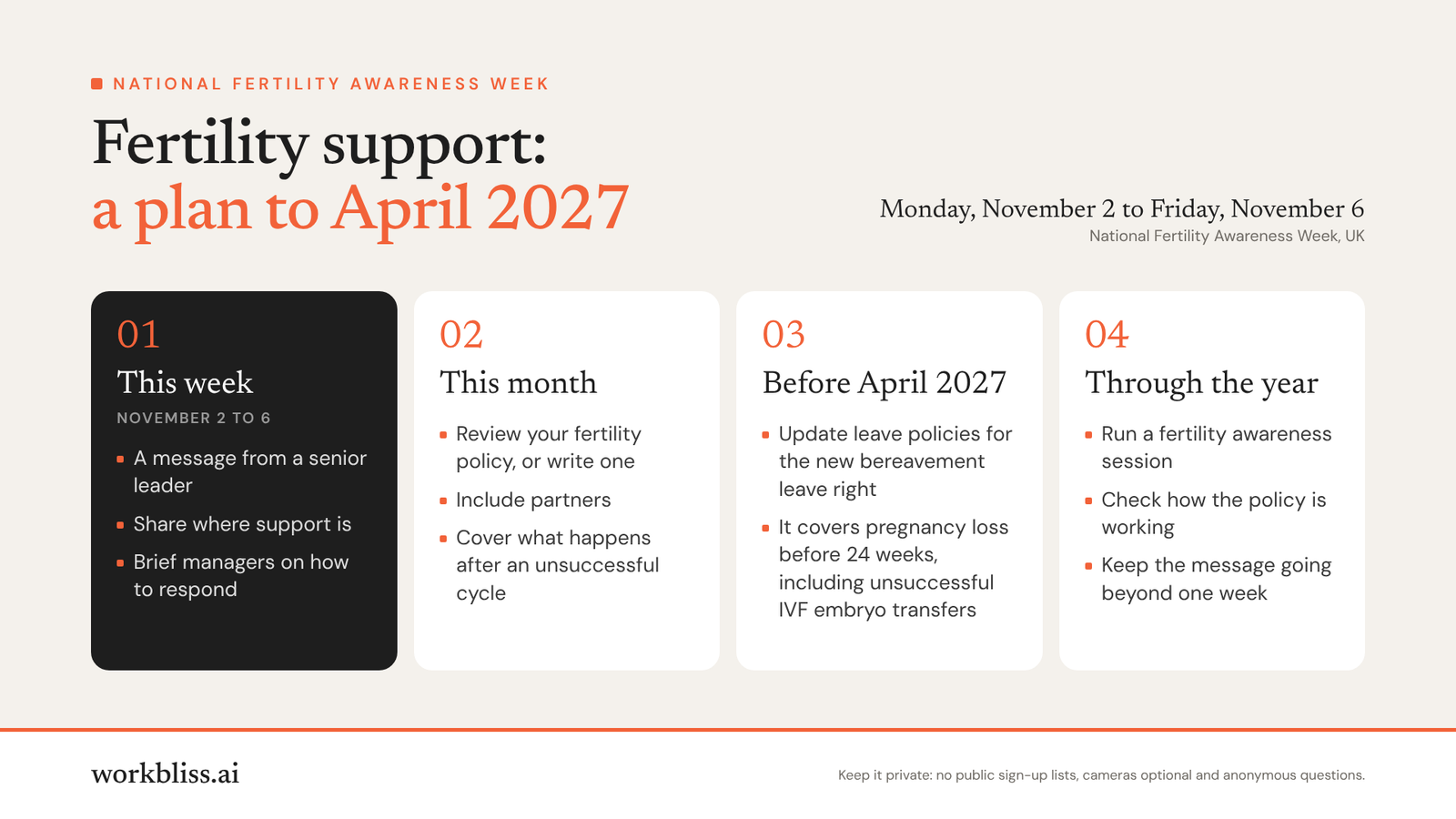
- This week, November 2 to 6: send a message from a senior leader, share where support is, and brief managers on how to respond.
- This month: review your fertility policy, or write one, and make sure it includes partners and covers what happens after an unsuccessful cycle.
- Before April 2027: update your leave policies for the new bereavement leave right, which covers pregnancy loss and unsuccessful IVF embryo transfers.
- Through the year: run a fertility awareness session, check in on how the policy is working, and keep the message going beyond one week.
Where Workbliss fits
Workbliss runs prevention-focused workforce experience programs for global employers, with one plan and one point of contact for every office. For National Fertility Awareness Week, or any time after it, these sessions fit:
- Fertility, Pregnancy and Postnatal Support at Work, led by a qualified health educator, for everyone
- IVF & Fertility Treatment: Navigating the Workplace, for people planning work around appointments, privacy and changing plans
- Male Fertility: What Men Need to Know, and Men's Health Essentials: What Every Man Needs to Know, which includes male fertility
- Health Conversations Without Overstepping, for managers who want to respond well without diagnosing or prying
For women's health more widely: Preventive Health for Women, a Women's Health Consultation Clinic at your office, with private consultations from menstrual health to menopause, and Returning to Work After Maternity Leave.
Every session runs online or in person, in your people's languages.
We usually need 14 days' notice. National Fertility Awareness Week has already started, so if you'd like to mark it this week, email hello@workbliss.ai and we'll see what we can do. Fertility support isn't a one-week topic, so a session later in November or in the new year works just as well.
Talk to us about fertility support
See the women's health sessions
Frequently asked questions
When is National Fertility Awareness Week 2026?
National Fertility Awareness Week runs from Monday, November 2, to Friday, November 6, 2026, in the UK. This year it's led by the charity Fertility Action.
Is National Fertility Awareness Week the same as National Infertility Awareness Week?
No. National Fertility Awareness Week is the UK's week, held in the autumn. National Infertility Awareness Week is the US week, held in April. Global employers can use both to keep fertility support on the agenda twice a year.
Do UK employees have a right to time off for IVF?
Not specifically. There's currently no statutory right to paid or unpaid time off for fertility treatment in the UK. Once an embryo has been transferred, the person is protected as if they were pregnant, and from April 2027 a new bereavement leave right is due to cover unsuccessful embryo transfers. Many employers offer their own paid time off or flexible working for appointments.
How should a manager respond when someone says they're having fertility treatment?
Thank them for telling you, listen, and ask what would help, rather than guessing. Keep it confidential unless they agree otherwise. Talk through practical options, like flexible hours for appointments, and make sure they know about your policy and your employee assistance program. Check in regularly, because treatment can take months.
Should a fertility policy include men and partners?
Yes. Infertility can involve either partner, and partners attend appointments and share the strain. An inclusive policy covers men, same-sex couples, single people, and people using donors or surrogacy.
How do you support fertility across global offices?
Agree on one set of principles, like confidentiality, flexibility for appointments and support after loss, then check the rules in each country, because leave rights and health plan coverage vary a lot. Run sessions in people's languages, and at times that work in each time zone.
Is it too late to plan for National Fertility Awareness Week?
No. A leadership message, a guide to existing support and a manager briefing can all happen this week, for free. Sessions can run any time. If your date is less than 14 days away, email hello@workbliss.ai and we'll see what we can do.
Sources
- World Health Organization, "1 in 6 people globally affected by infertility," April 4, 2023. https://www.who.int/news/item/04-04-2023-1-in-6-people-globally-affected-by-infertility
- Human Fertilisation and Embryology Authority, "Number of IVF patients triples in 30 years, says fertility regulator," June 16, 2026 (data from 1991 to 2024). https://www.hfea.gov.uk/about-us/news-and-press-releases/2026/number-of-ivf-patients-triples-in-30-years-says-fertility-regulator/
- Human Fertilisation and Embryology Authority, "Fertility treatment 2024: trends and figures." https://www.hfea.gov.uk/about-us/publications/research-and-data/fertility-treatment-2024-trends-and-figures
- Fertility Matters at Work, This Can Happen and Ferring Pharmaceuticals, "The Impact of Fertility Challenges at Work: International Insights," November 2025. Over 3,600 employees and employers in Australia, France, Japan, Poland and the UK. Funded by Ferring Pharmaceuticals. https://www.businesswire.com/news/home/20251125104720/en
- Padma Tadi-Booth, "IVF and employment law: What HR needs to know," Workplace Journal, January 22, 2026. https://workplacejournal.co.uk/2026/01/ivf-and-employment-law-what-hr-needs-to-know/
- Baker McKenzie, "United Kingdom: The new right to bereavement leave," October 22, 2026. https://www.bakermckenzie.com/en/insight/publications/2026/10/united-kingdom-the-new-right-to-bereavement-leave
- UK Parliament, Fertility Treatment (Right to Time Off) Bill, first reading November 4, 2025. https://bills.parliament.uk/bills/4032
- Fertility Network UK, National Fertility Awareness Week. https://fertilitynetworkuk.org/national-fertility-awareness-week/